My blog about my wargaming activities. I collect a lot of 15mm miniatures for the American War of Independence and so collect a lot of rules for this period. I started miniatures with Napoleonics, so I have a number of armies in 6mm and 15mm figures for skirmishing. I have15mm WW II figures that I use for Flames of War, Memoir '44, and someday, Poor Bloody Infantry. Finally there is my on-again, off-again relationship with paper soldiers that I sometimes write about.

Showing posts with label painting. Show all posts

Thursday, October 27, 2022

News and Such

Face-to-Face Gaming

Fistful of Lead

As you saw with the last blog post, I recently tried out the rules A Fistful of Lead (Reloaded), which focuses on the Old West. Although I made a hash of the rules I have since purchased A Fistful of Lead Core Rules and Fistful of Lead Fantasy: Might & Melee. The Reloaded rules are an abbreviated/simpler version of the Core Rules and does not have all of the options and nuances available to the player that the latter two do. Honestly, the differences in the core mechanics are so small, especially viewed in terms of increased page count, one wonders why Reloaded stripped them away. I hope to try these rules again with gaming buddy Bill.

Brigade Fire & Fury

I am part of a Facebook gaming group dedicated to gaming in the SE section of the state and I have always noticed that one person was always posting about the terrain boards he was making and the figures he was painting – ACW, Napoleonics, and Napoleonic-era Age of Sail – just massive amounts of work. He would invite people to come to his house and join in, but he rarely got a response. I asked him where he was and he told me a place out in the middle of nowhere about 2 1/2 hours away. (Hey, this is SE Arizona. We are all practically out in the middle of nowhere!) His games were on Friday nights at 6 PM and I could just never make it. With three hours of prep and driving that would mean I would need to leave at 3 PM. That was possible when I was working but then there would be the gaming of at least two to three hours, then another 3 hours getting back. I was thinking that would be about midnight before getting back, after a (partial) day of work. It just sounded too taxing. Now that I am retired, I decided to give it a try, only I decided to stay in a cheap motel and make the drive back the next morning.

First off, it is a nice drive there, not too bad. I drove through the city of Tucson between lunch hour and rush hour so traffic was not too bad. On the way back I took a different route (not the interstate) and it was a very nice change (for desert terrain).

The game played was a pseudo-Gettysburg battle oriented towards learning the Brigade Fire & Fury (BFF). The host is building a 12' by 6' game board for playing Gettysburg in Warlord's Epic ACW scale, which I believe is 12.5 mm. He wants to play Gettysburg soon and this was a dry run of sorts. He is also building a Waterloo game board and the corresponding forces for that. His collection was truly daunting.

It has been some time since I have read the Age of Eagles rules, the Napoleonic variant of BFF, but I slowly got the hang of the rules as the turns rolled by. As you can see from the image below, it was a fairly sizable game. We (the Union) "won" but that was because we substantially outnumbered the Confederates and our rolls to move were definitely better, so we reached the objective (the central ridge) first, forcing the enemy to charge uphill to dislodge us.

At some point the host will finish up his painting and the game board and he will do another dry run of the game. If I do it again I will have to be sure that I get a better hotel room as this game lasted four hours and my back was killing me reaching across this 6' deep board and I needed a much softer bed!

Still More Marvel United

Our Marvel United games are still chugging along every Monday night. I lost one player to pickle ball and Middle Earth Strategy Battle Game but picked up another so we still have four to six players each game night.

Here is the Loki figure that I painted. Not a powerful villain, but still interesting.

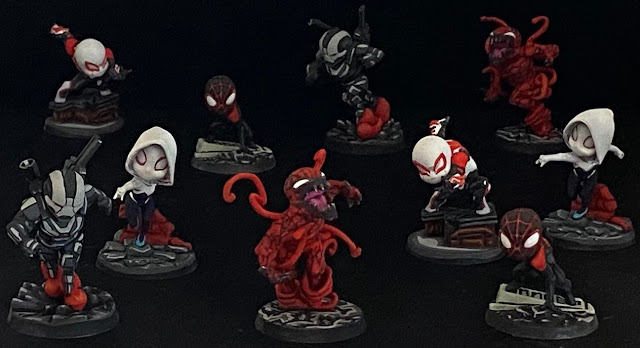
I also commissioned Spiderman 2099, Miles Morales, War Machine, Spider Ghost, and Carnage, plus a few others not in this picture to be painted by Smooth Blend Studio and I think they turned out very well. The X-Men core set is being worked on right now.

Playing Around with Laser-cut Base Designs

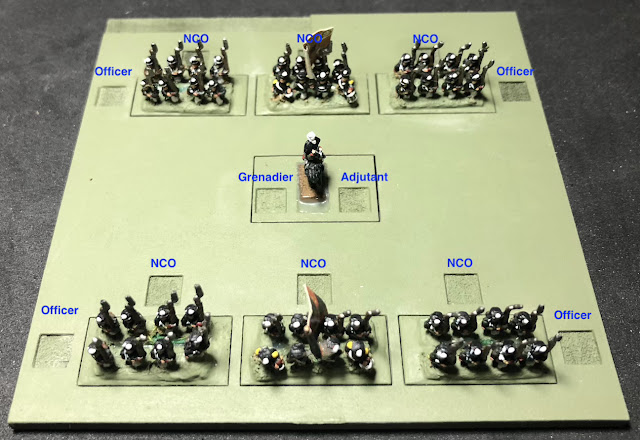
I have been playing around with multi-use base designs again. Right now I am working on my 6mm Napoleonics whereby each group of figured is mounted on a 1" by ½" base which slots into a large 4" wide base for use in One-Hour Wargames. I intend to add additional figures as decorations to the base. As you can see in the image below, I will place line officers at the ends of each unit, NCOs behind them, and a general and his staff in the center of the base.

Russian Napoleonic Infantry 'Brigade'

If I were doing more of these units I think I would decrease the depth of the base so there is less empty ground between the two units and probably put the command staff at the rear.

The space showing in the upper left corner (which is actually the lower right corner when the base is facing away from you) would be were a label, specific to the rules you are using, would be affixed.

When I bought the rules Men of Bronze from Osprey I thought to myself "do I want to paint up a new set of figures (I have them in a lead pile) or do I want to take my huge DBA collection and rebase it?" I was thinking along the lines of something like this.


The idea is that I would base each figure separately, on a small base (white rectangles with a red line). When playing DBA (upper left and upper right) the number of figures per base and the base dimensions (gray rectangle with black line) would be correct. But I could then pull the individual figures out and slot them into larger individual bases (lower left) and use them for other systems.

The one catch in all of this is that one set of figures I would really like to use with this basing scheme have a beautiful basing scheme. The idea of destroying that for something lesser I would do is hard to contemplate right now.

I have been thinking about doing the same sort of scheme with my 15mm AWI figures. Currently some are based 2-3 figures on 40mm by 20mm bases, single figures on ½" square bases, and single figures on metal washers (of at least two different sizes). This scheme is sort of a 'cake and eat it too' dream.

That said, I may get rid of these figures...

My Wooden Soldiers

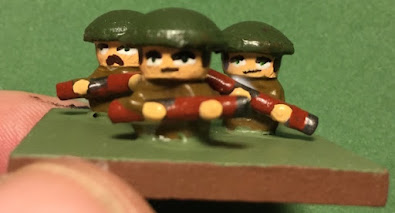
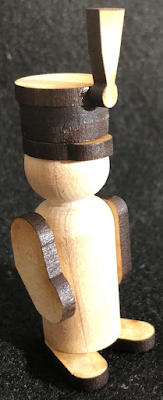
I have always enjoyed making my wooden soldiers. I have heard people say "that takes too long", but once you've assembled multi-part plastic models, scraped off their mould lines, and filled in the gaps you realize that making minimalist figures like mine is actually quicker. Also, having no cast details means you can paint only those details you want freehand, so it goes much quicker.

WWII British Infantry

Every time I bring out my wooden figures, or post them in battle reports, people always remark on them. I once played in a DBA tournament with handmade wooden figures and no one refused to play against me because 'they aren't real miniatures' as I imagined they might.

I know one of the things that has stopped me from selling many of my miniatures has been that I don't want to 'lose capability', i.e. not be able to play a genre or specific ruleset because I sold my miniatures. I also find myself trying to find rules to use because I have painted miniatures and the ones they were originally painted for have fallen out of favor. (WWII and Flames of War comes to mind. I like Hail of Fire, but they keep changing because the author comes up with great new ideas.)

So my new plan is to make and paint new miniatures for the collections that I have – maybe not so many this time – and then when it is replaced with wood, sell off the metal and plastic. (It is going to be hard to part with my beautifully painted Thracians though. I may keep them just for display.)

What do you think?

Scale75 Instant Colors

As those who have read this blog for a while know I have been experimenting with Citadel Contrast Paints, Army Painter Speedpaints, and transparent acrylic inks, washes, and paints. The idea is to paint a figure white, or primer black and then dry brush gray and white to highlight (now called the 'slap chop' method), before putting on the transparent colors. I like this style but have struggled with the various products.

To date, Citadel has been the winner, but as I watch more videos I have come to realize that the manufacturer's advice on how to use all of these products – one thick coat – is not the way to really use it. Better to use thinner coats and allow the dark and light of the undercoat show this. (Called 'value sketching'.)

There are several other competing products out there, mostly because Citadel's Contrast Paints have been so wildly successful, but I have not tried them. Green Stuff World's Dipping Inks, the upcoming Express Colors from Vallejo, and Scale75's Instant Colors have all been avoided, until now.

When I saw the first videos of Instant Colors – on Scale75's YouTube channel no less – I thought the results looked absolutely horrendous. Blotchy and pale. For some reason a video popped into my feed about 'underpainting and Instant Colors' and because I am always interested to see what color people use to underpaint with – such as underpainting with pink if the color will be yellow – I decided to watch it. I was actually amazed that the final product was so good and he used Instant Colors. So I went out to a hobby shop and bought one set (8 paints for $50) to give it a try.

What I found is that you need to treat these like paints, i.e. use thin coats and not thick ones like the manufacturer suggests. Unlike Speedpaints (and many Contrast Paints) which are very saturated with one coat, Instant Colors increases saturation as you lay down more coats. The figure below shows what I mean.

One Coat Two Coats Three Coats

Okay, they fewer the coats, the blotchier it is, but seriously, the above looks like they came from three different bottles of paint. Further, because they act as filters due to their transparency, if you use different colors on top of one another, you effectively make new colors without mixing. This document provides a really good example of what each Instant Color looks like over a specific color of primer. This has been my second most serious complaint about Speedpaints; they are too saturated and you have to thin with expensive medium to desaturate it. With Instant Colors it looks like it would be much easier to replicate the desaturated color palette from pre-industrial dyes. (That is a good resource for what colors to really use, by the way.)

So, as this is more the way I like to paint now, white base with transparent colors, followed by blacklining with inks to separate colors, Instant Colors not providing a strong contrast actually works better for me. (I went out and immediately bought a second set to test.) It will be interesting to see how this plays out on wooden figures.

Well, that is it for now. Next time, an update on one of my favorite rules, Tin Soldiers in Action and a report from a convention I will be attending. (Unfortunately not Fall-In 2022.)

Saturday, July 30, 2022

More Painting, More Thoughts on Downsizing, Goodbye My Friend

I have been doing a lot of painting of late, as part of my trying to figure out which scales to keep and which to shed.

Wooden Warriors – French (Napoleonic) Marine of the Imperial Guard

One only my Wooden Warriors blog I finally made two posts. The first was about how to use my laser cutter for something other than making paint racks and wooden bases; I decided to take a different approach to making Napoleonics shakos. I did a test and then painted up this French Marine of the Imperial Old Guard.


6mm Napoleonics Painted with Citadel Contrast Paint

Someone on one of the Facebook groups had asked about whether anyone had tried painting 6mm miniatures with Citadel Contrast Paint. As I had done some 15mm in the past, I decided to give it a go and report on the results. I decided to try a harder subject that the standard Space Marines or Space Elves; I went with Napoleonic-era Bavarian troops.

First a couple of notes. Firstly, 6mm closeups always look horrible; they just do. You really find out how shaky your hands are when you photograph 6mm troops. You can actually see details, flaws really, that you just don't see when you are looking at them about 1' away (or farther).

I started by priming the miniatures white with Pro-Acryl white primer. It is a nice, thin white that does not clog the detail, which is important with 6mm, especially if you are going to use Contrast Paints or Speedpaint. As there are older Baccus sculpts, they are very rough and thus will take these types of paints well.

Here is what they look like, fully painted. (I later took a little more white to the trousers and cross belts to make them more solid.)


Overall I was good with the results, but I really need to look at the results of figures that are more crisp. The older Baccus sculpts are very 'rough' and I was not keen on them. But I love the newer sculpts. Also, using the gray Contrast Paint as a replacement for metallic paint is not really a good idea, so I would change that and go back to a gunmetal color.

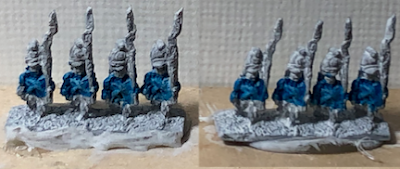
Next up are Xyston 15mm Later Achmaemenid Persians. I bought a ton of Xyston 15mm ancients when Brookhurst Hobbies had a clearance sale and I have had them heaped in a pile of shame every since. (Greek Hoplite and Thracians are two of the armies that I vowed I would have a large collection on, one day. They would practically all be Xyston miniatures too.)

I started off airbrushing on a Zenithal primer. I started with Pro-Acryl black and fully covered the miniature. Then I swapped in Pro-Acryl white primer without cleaning the pot, knowing that it would come out gray. I liberally covered the figures, leaving only the undersides untouched. Finally I drybrushed white on top to pick up the highlights. 


Next I started carefully laying down the contrast colors, doing white touchups for areas where a darker color was laid down over an area where a lighter color was intended.


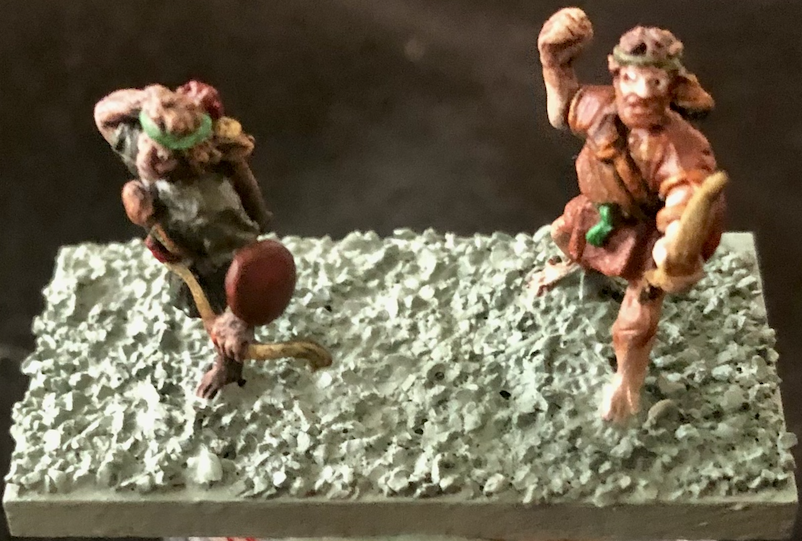
Here are the final results. For the most part I had to use light, opaque highlights over the areas with Contrast Paints to remove the 'tide pools' and 'coffee stains'. The newer Contrast Paints that have less contrast, such as the bright yellow on the purple and yellow figures, as opposed to the yellow-brown on the other figures. The former did not require yellow highlights (I actually shaded with Shade Paints), while the latter definitely did.


Overall I think the older Contrast Paints are too 'brutal' for 15mm. It is better to go with a base color and use Shade Paint or a wash to collect in the recesses. If you want three colors go with a base color as a mid-tone, highlight with a lighter color (use more contrast between the base and the highlight than you would with 28mm figures), and then wash with a darker color. The tint from the wash will tone down the mid-tone and highlight, bringing down the contrast, and match well with the shadow color it gives the recesses. For me, Contrast Paints do not seem to be the solution for 15mm. It flows too well for the scale.


The last experiment came from watching a video by Bunker6. He paints a lot of Games Workshop Epic Warhammer 40,000 figures – roughly 6mm – and he puts a lot of detail into them. I decided to see if I still had my eye and hand (because if not, the unpainted 6mm were going to be on the chopping block).

I started with the new Imperial Fist Yellow Contrast Paint because: 1) these are meant to be Imperial Fists; 2) I don't have any other yellow that is that exact hue; and 3) these are supposed to be one of the new single pigment colors that cover well and are low contrast (which is ironic for a 'contrast paint'). First off, it does cover well and the flow characteristics are generally nice, but the smaller the scale the less you want your paints to flow. As this was my base coat for the model, and nothing was going to be a lighter color, I did not care that it flowed off of the areas where I put the brush. If anything, it ensured that I did not miss a spot.

Personally I think I put in a little too much detail, but nonetheless I went forward with the exercise because I wanted to see whether the effort was wasted or not. I already consider this picture too zoomed in for tabletop view, but not so close that it looks closer than bent arm's length (the range most people generally use when they pick up a stand to look at it). I can still see the attempt at details, like the grey behind the knees (rubber parts in the armor), the black stripe on the helmet, the red glowing eyes, and the black and silver bolt gun. I can also see one other detail that you probably don't see and that is only because I intentionally painted it: I painted a yellow highlight color and a yellow shade color. Is it worth it? Not sure. But I answered my question: I can still paint 6mm troops to an acceptable table standard with my eyes and hand.

A Note About Army Painter Speedpaint

My experiments with Army Painter Speedpaint has been disappointing. Largely because they are not really acrylic paints, but some form of 'resin' paint. Water causes them to reactivate, so adding acrylic highlights over them causes them to partially blend with the color being painted on while also popping the color off of the primer, exposing the white (or whatever the primer color was) below. Not a good effect because you cannot really control it. Dana Howl (YouTuber miniature painter) was the first that I saw that suggested the way to deal with this was to mix your acrylic paint with either Speedpaint Medium or another Speedpaint color, effectively turning it into a custom Speedpaint color. A lot of people must be doing this because Speedpaint Medium is very hard to find right now and where you can find it, it is double its normal price.

One thing I have found out for sure is to not mix Speedpaint with acrylic mediums like matte medium, glaze medium, metallic medium, etc. It makes it into a gloppy mess that spreads even worse than Speedpaint, that Flow Aid or water does not seem to fix.

At this point I see Speedpaint as an 'all or nothing' solution.

Sad News

More than 15 years ago, while still trying to build a gaming club in Sierra Vista, Arizona, I was searching The Miniatures Page for players who might be within driving range, but were to the east (i.e. we were closer than Tucson, Arizona) and thus underserved, gaming-wise. I found Marv and Betsy Schmid and despite them being five hours away (in Deming, New Mexico) they said that they would be happy to hop in their camper and come to Sierra Vista and teach us this game called De Bellis Antiquitatus (a.k.a. DBA). They had numerous armies and all the terrain we would need. It was a smashing success, such that many of us started collecting DBA armies. It also led to the discovery of HOTT, me creating American War of Independence version of DBA (DB-AWI 2008) and HOTT (HOTR 2009), and even a blog (now inactive) about my DBA games.

Over the years my wife Rita and I have alternated visiting with Marv and Betsy, us going to their house or they coming to ours. Gaming buddy Don and I once dropped by on the way to a DBA tournament in Albuquerque, New Mexico for inspiration and last minute tips. We even went to a state park with a lake together to swim, camp, and game.

Part of what I have been doing of late is re-connecting with people that I haven't spoken to during the lockdowns, especially those that are not in my immediate area. That has led to some great conversations with people across the country and around the world, but sometimes it leads to sad news. It took finding an old mobile phone, recharging it, and retrieving the phone number I failed to transfer over to my new phone to finally reconnect to Marv and Betsy, only to find out that Marv had died last May of brain cancer.

Needless to say, Betsy is still trying to cope with the loss, but Marv had a large wargaming collection and she was trying to get a hold of me in hopes that I would take it off her hands. Right when I am trying to downsize my own collection… So, right after I retire next month I am going to head to Deming to inventory his collection, see what I think I can "move to a good home", i.e. what is sellable, and work with her on managing the sale of his collection. Hopefully I can sell things off on Facebook, The Miniatures Page, Fanaticus, and eBay and send her checks periodically. I know it will be a lot of work, but it is a bit of repayment to a couple that showed us a part of this great, fragmented hobby that ended up being a big part of my wargaming experience (and this blog), plus it will show me how to reduce my own collection.

In a way this is something I have been considering, and although it is a bit morbid, it is something we need to consider. What will happen to your collection when you pass? Are you sure the kids will take it? Are you sure your friends will? Do they know they are going to be tagged to disposed of your collection? Is your wife expecting to recover some of the costs of your hobby? Does she know that you "invested" in a depreciating asset? Does she know who to contact about your collection? Does she know how to sell it? Does she know a reasonable price? (Do you? When was the last time you sold?)

I posted a message on a DBA forum on Facebook to try and get a sense of what the market for painted 15mm DBA armies is. Ten years ago I used to scour eBay, Fanaticus, and TMP for painted DBA armies and paid what I felt was a premium buying them. But I stopped playing DBA after 3.0 fragmented the player base. Like Flames of War 3rd and 4th Editions, I just couldn't get into the next edition, despite buying the new rules. I was done. And with that exit went my knowledge of how viable the market was.

Fortunately, it appears that the market is still good. Not only are people still playing DBA 2.2, 2.2+, and 3.0, there is a new derivative called Triumph, but it appears that Art de la Guerra (ADLG) using the standard DBA basing. So I feel better about taking on his DBA collection to sell for her. His WW II and Arab-Israeli micro armor, however, jet age Check Your 6 aircraft collection, however, are a different story. But just like the old joke about how to eat an elephant (one bite at a time), so to with how to move someone's lifelong collection. Enough whining!

Here's to you Marv. You will be missed.


Monday, July 04, 2022

Personal News, Wargaming Thoughts, and Some Painting

 Personal News

Let's get this one out of the way. First off, I am retiring in about six weeks. I am 60 years old (and I turn 61 in October) and although I planned on retiring October 2023, circumstances force me to retire early.

I am a computer programmer by trade (in the U.S. home mortgage software market – talk about niche) and I have always said that I could probably continue on even if my hands went, because there is such good voice recognition technology out there, but if my mind ever went, I was done for. I used to be known for my attention to detail, but lately I have not been able to focus. I am easily distracted. Worse, I don't just forget where I left off at, I forget that I was not finished with a task and my mind tells me I was.

This apparently happened pretty quickly. My company awarded me a huge bonus and raise last January for being a top performer in the company (Zillow); now I can't remember to complete a task.

I knew it last Tuesday when I was in a Root Cause Analysis (RCA) meeting – otherwise known as a "who screwed up" meeting – and someone was showing a result from my application and I knew it could not "have happened". The previous day I had changed the code at their request and there were three dates in the change. My documentation (rare for a programmer) noted all three changes. The comments in the code noted all three changes and the change number that ordered it. And the code was changed … in two places. I must have gotten an email, chat message, or phone call and by the time I was done, did not remember that I had not finished. But it was not just forgetting; it was my mind being sure that I was done. Not a single thought of "oh, I have to check to ensure I finished that".

Lest you think I give up easily you have to understand that this was simply the last event in a long line of them that I was not admitting to. In fact, I was started to even hide them. I would blame this or that for why things went wrong, but the reality is that it was me.

I called my brother (four years older) because I remember him saying about six months ago that he had been diagnosed with something, and I wanted to be sure what it was. He has Parkinson's. We talked about it and I am pretty sure I do not have that. I have none of the motor skill symptoms. Also, mine is not a feeling of forgetfulness. I am not one of those people always saying "now what was that I was trying to remember?" It does happen on occasion, but my problem is more an arrogant assurance that I have remembered something – like finishing a task – or not even thinking to do something.

So, I decided that I did not want to go from 2021's top performer to 2022's guy that we want to get rid of. I want to be able to leave with a little dignity rather than milk the job for every last dollar until they feel like they have to fire me.

Fortunately, I have been a lifelong saver and I married a woman more frugal than I am, so I can afford to drift the remainder of this year and all of next year. I can pull sufficient money out next year from my retirement fund (we call it a 401(k) in the U.S.) and draw on Social Security at 62, if I want.

So What is Next?

I decided to give my company four weeks, so that I could transition my work and archive of code to a new person on the team. If they get someone in to replace me, all the better, but I have pretty specialized skills. It took them nearly a year to find me.

My manager reminded me that Zillow pays out its bonuses partially every quarter and that if I wait an additional two weeks that means I accrue about 500 more shares of Zillow stock (which declines in value every day), so I decided to wait for that. I am already leaving a lot of money on the table, but no need to rush out that quickly.

After that I need to head to a neurologist and figure out what is going on. My brother, who is a research scientist (his specialty is mosquitoes and pesticides) thinks we were poisoned as kids (Florida was famous for spraying residential neighborhoods with "safe" pesticides in the 1960s and 1970s), so hopefully it is something treatable for me.

If not, well that I why I want to leave the workforce now. I want to spend the rest of my time doing all of those things that I always told myself I would do "when I finally retire". I am going to paint and game, of course, continue doing more blogging, but also travel more. The wife and I are looking at using AirBnB to visit various places in Panama, for example.

Another project is to get rid of old games and junk that have accumulated that I just know I will never get to again. We all go sometime and the last thing I want to do is burden my wife or the kids with having to get rid of "the crazy old man's toys". Not that I think I will get any money back for it. More that I would like to see it go into someone's hands that would us it. (One of my gaming buddies did the same to me about three years ago, giving me all his Spanish Civil War 15mm troops that he knew he would never get to. I never got to it either.)

Multiple Scales and Multiple Genres

Which leads me to this topic. I have long been pondering getting rid of some miniature collections. But which ones? I rarely considered, when looking at shiny new figures to buy, whether I had all of the necessary accessories to go with those figures. Largely I mean terrain. Sure, there are some things that work across periods, like hills and trees, but building, other structures, even roads can very much be period specific. (It is funny how many times I use roads with 15mm scale tank treads showing for roads in my 15mm Ancients and AWI games, and as foot paths in my 42mm Dark Ages games.)

What scales should I keep? (I have collections in 6-8mm, 15-18mm, 25-28mm, 32mm, and 42mm, with a few, rare pieces in 2mm, 3mm, 10mm, 20mm, 1/72nd, and 54mm.) What genres should I keep? (I have collections in … uh, never mind.)

I always thought about having one (smaller) scale for mass battles and one (larger) scale for skirmish games. But that is still potentially two sets of terrain. Here are the conclusions I came to so far.

6-8mm: I like this scale for one reason, and that is because I now have a tendency to play games on smaller areas, like 20" x 30", 2' x 2' and 3' x 3'. Figures that are 6-8mm work great for this size table. There are just two problems: 1) my eyes are failing so painting them is hard; and 2) I find it very hard to identify what the troops are, especially if I try and use 'realistic' basing with flocking, sand, etc. Some of the best terrain I have for this scale are old Monopoly houses and hotels, which you can buy very cheaply on eBay.

15-18mm: I have a lot of troops and terrain in this scale. The largest collection is probably Ancients/Dark Ages/Medieval, but they are in DBA-army size groups, i.e. about 12 stands per 'army'. Second is AWI and third is WWII. Terrain is largely for WWII. (My terrain for DBA was always flat felt or foam rubber because no one used realistic terrain, as it got in the way of game play.) The ability to paint this is better than 6mm and I can recognize troops better. I keep telling myself that this is what I will focus on.

25-28mm: For me this is the nostalgia scale. I started miniature gaming with 25mm Napoleonics. I still have miniatures that I painted back in the 1970s and 1980s, plus too many old (valuable) Citadel miniatures from the 1980s and 1990s. What I do not have anymore, is terrain. Further, the little terrain I do have is Space Gothic. (You know what I am talking about.) This scale is very paintable, vision-wise, but due to their larger surface area it takes more time. Also, manufacturers are cramming the details on these things. Finally, if you decide to go with this scale, storage of miniatures, and especially terrain, starts to become an issue. On the positive side, other people are more likely to be using this scale. (But I generally provide both sides anyway.) Also, there is the question of whether I can play anything other than skirmish games at this scale if I do not have a 6' x 4' board.

On a side note, Marvel United is basically somewhere around this scale (or 32mm), but I consider it an exception to the 'keep or dump' decision. Unlike traditional miniatures, the figures in Marvel United are very much tokens for a board game and thus the idea that you need terrain for them isn't true. So, I will keep these as they neither fall in the skirmish or mass category for tabletop wargaming. One might include all miniatures from board games, in which the terrain issue doesn't exist, in this same sort of category. That would mean my Star Wars figures from Imperial Assault could be kept.

32mm: Although the new figures from Games Workshop might fall into this category, for me it was Star Wars: Legions. As a rule set it is definitely something I no longer play, nor will pick back up, so these are a definite candidate of figures to clear out.

42mm: The only miniatures that fall into this category are my wooden soldiers that I make. I have a Napoleonic and Dark Ages collection, along with appropriately scaled trees, but not much else in the way of terrain. Felt always works for roads, rivers, plowed fields, etc. As long as I stay away from structures, I am good. Ironically, I have found it easy to play skirmish games with these figures, but mass battles require a 6' x 4' table. I tend to use smaller unit sizes (6 figures or so) anyway I tend not to put a lot of figures on the table. The largest hassle with this scale is the larger surface area requires more paint and time, with a tendency to want to add detail as it is so visible.

I know one of the first tasks once I retire will be to get rid of all my 32mm Star Wars Legion troops, followed by the 28mm Bolt Action, Warhammer, and Warhammer 40,000 figures, both painted and unpainted. If I get rid of all of those, I may not have to make the decision between 15mm and 6mm. The 6mm collection is actually pretty small, physically. Also, there are some incomplete line in my 15mm collection to get rid of like the Marlburians, Polish 17th Century, Renaissance WoFun figures (experiment that failed), and even Napoleonics (my 6mm Napoleonics collection is far larger and more consistent).

My goal is truly not to buy any more.

Recent Painting Videos

As part of my resolve to move away from 25mm to 32mm figures strengthens I realize that I need to either paint or sell all of the 15mm figures that I already have. I have a number of random AWI figures that need treatment, plus have a number of WWII troops from the Flames of War days to be painted, but by far the largest collection is unpainted Ancients. I remember Brookhurst Hobbies had a 50+% sale on Xyston Miniatures – and I love those sculpts – and I purchased a couple hundred dollars worth at sale prices. Maybe 100+ packs? Some insane amount. I have a whole 33 liter/35 quart storage tub filled with these packs. (I admit temporary insanity.)

Nonetheless, I saw a painting video using Army Painter's Speedpaint – which I bought as soon as it became available, in order to give it a try – for historical miniatures and I decided to give them another try.

My initial complaint with Speedpaints is that it was too blotchy, like Citadel's contrast paints. Added to that the paint reactivation issue that Youtubers talked about and it seemed like it was off to a bad start. I gave them another shot anyway and I must say that I think they work better for 15mm because there are no large, flat surface areas (unless you are paining vehicles), so you just don't see the problems. As for reactivation, well I just make sure I seal them with a spray varnish rather than a brush-on one. The one thing I do know is that they do not like traditional acrylic mediums and flow improvers. I would also use a separate set of paint brushes with them (as I do with Citadel contrast paint, India inks, acrylic inks, varnishes, and gesso).


Recently I have been watching more painting videos about all kinds of subjects. One came in my feed from an artist named Warhipster, whom I had never watched before, and he talked about why Citadel contrast paints produce blotches, pools, and stains, and how to use them properly. I swear, if all you do is watch the opening sequence you will see someone paint the smoothest finish with contrast paint I have ever seen, all without dilution or mediums.

It was this video that had me break out the contrast paints once again. Of course, just when I do that Citadel decides to increase the size of their line of contrast paints and have changed their Shades line to use contrast paint formulation, so they are weaker (wash) versions of contrast paint. It makes sense because washes and contrast basically do the same thing, which is appear stronger in the cracks and crevices and weaker everywhere else. With washes (Shade) we just want that tint to be as weak as possible while still maintaining sufficient color strength in the cracks. The bad part about the new line: I hear it will cost $195 to buy all of the new contrast paints. (I am not even sure that includes the new shades.)

I have lots of Arcadia Quest chibi-style figures to paint (in addition to my Marvel United figures). I painted this monk up with contrast paints and shades in very short order.

I started by priming him bright white rather than the typical black then white zenithal. I spent some time inking him with a black micron pen before sealing it with varnish (so the ink would not reactivate from the solvents in the contrast paints). At that point I was ready to color the figure, much like the process in old school comic books (draw, ink, then color). You can see the blotchiness of the colors – I clearly need to watch the video above again, and practice more – but I think the overall effect is acceptable, especially given the time it took to get the figures on the table.

In addition to all of this I reconnected with Matt, my co-author on the Wooden Warriors blog, to see how things are faring with him. (Things are fine, but he finally caught Covid after dodging it for more than a year of teaching classes.) Neither of us have made a post there (I hope to rectify that soon), so I wondered whether he dropped out of the hobby or whether he was simply not making figures anymore. It turns out he has revived his interest in old board games, like Heroquest, and had obtained a set and was merrily painting away. He told me about a Spanish YouTuber living in Malaysia and his channel Rush the Wash. His technique to is zenithal prime and then use contrast paints to get his figures out on the table quickly. (Previously he white primed and used Citadel shades, glazes, and inks – the latter two some very old products – to paint his figures.) Ironically, this was a style I had been trying to accomplish for a long time. A long time ago – we are talking late 1980s here – I used to paint a number of things with Higgins, Windsor & Newton, and Bombay India inks. These days it seems like few places, other than online art supply stores, carry a decent range of colors, so I drifted away from it. However, I purchased a DBA army or three from Timurilank in the Netherlands and I saw that he had a transparent color glaze look to his figures – you can see an example in the first picture of this post on his blog – that I have been trying to replicate for awhile. Rush the Wash was all about that style. Also, you can find videos from a few others on the "slap chop" painting style, but I think that is less distinct. I think my 15mm ancients, above, reflect that style, only without the gloss varnish.

More Marvel United

We have been playing a lot more of this board game, both as a group, face-to-face, and virtually using Tabletop Simulator. The former games give me more incentive to paint my miniatures while the latter allows me to play a campaign with other people around the country.

Here is what I completed on my painting table. First up is Silver Surfer. We played him once and he was powerful, almost too powerful to play against anything but the strongest villains (like Thanos).


Because he comes pre-paint in this chrome silver, all I did was add black ink lines to define him further, and paint the space-y base.

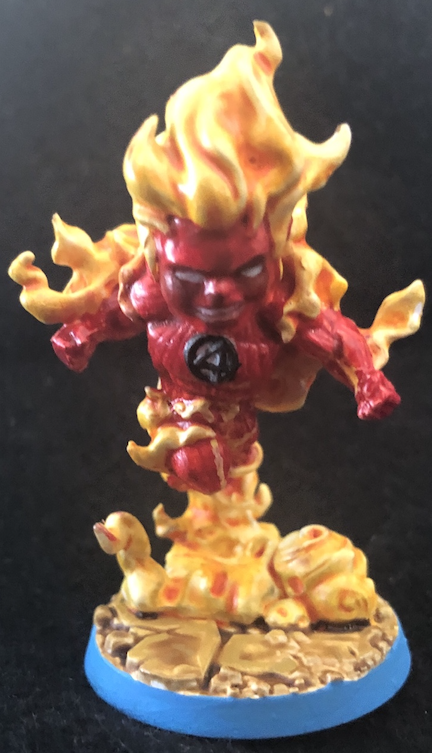
I decided that the first set from the Marvel United X-Men series that I wanted to paint was the Fantastic Four expansion. So I started with the Human Torch. He comes cast in an ugly transparent orange plastic, so I primed him white and used Pro-Acryl transparent red acrylic paint and Bombay crimson India ink for the body, and Pro-Acryl transparent yellow and orange acrylic paints and Bombay yellow and orange India inks for the flames. The base is contrast paint and Pro-Acryl acrylic paints for the highlights and base rim. The only thing I might add is thickening the black to outline the eyes.


In order to try and keep my "one new figure painted a week" schedule I decided to tackle The Thing next. He is contrast paint for the body with acrylic paint highlights. The shorts are Pro-Acryl blue transparent acrylic paints with acrylic paint highlights and the belt is all acrylic paints.


Last up is the villain Killmonger. On one hand I wanted to try a new technique, but on the other I was reluctant to use a different technique than I used for all of my other heroes and villains. This was a black prime with white zenithal and heavy use of contrast paints, shades, and transparent acrylic paints. There is very little opaque acrylic paint used, and it was only used for the highlights.


One of my gaming buddies is the person behind Smooth Blend Studio and is the one who painted many of my Warhammer Underworlds figures, plus the Guardians of the Galaxy expansion for Marvel United. He has opened up his schedule to paint 30 more figures for Marvel United, so expect to see more in the coming three months.

Saturday, June 11, 2022

Map Campaign Part 4, Other Updates, and Eye Candy

Map Campaign

This is the continuing saga of my solo map campaign, using The Solo Wargaming Guide (TSWG) for the campaign rules and Neil Thomas' One-Hour Wargames (OHW) for the tactical rules. If you missed it, here are part one, part two, and part three. So far I have fought the First Battle of Firnskuppe and the Second Battle of Firnskuppe. Much of this was inspired by the campaigns of Mr. Wargaming on The Joy of Wargaming Youtube channel. The goal of this campaign was to create a series of linked battles where each battle has some context and is not just a random, disconnected scenario. I wanted to produce some interesting scenarios, especially unbalanced affairs that you might never normally play in a face-to-face game. (So far, it has done that, but I am just getting started.)

The Action So Far

The Westonians launched a surprise attack, declaring war on the Eastonians five days after they had already started mustering their troops for a war. Because of this the initial action has been between the vanguard of the Westonian Northern Army and the frontier defense forces of a few towns in the line of attack, centered around the Eastonian village of Firnskuppe. Firnskuppe has been temporarily lost to the Westonians, but the Eastonians are mustering their Northern Army to take it back before the bulk of the enemy army arrives.

Meanwhile on the Southern flank, the Westonian Southern Army has started marching on the Eastonian town of Tierwelt. Unknown to them, Eastonian frontier forces are waiting for them in the extensive forest lying between the two countries. That engagement is the subject of today's post.

The Forest Battle

One of the other goals of this campaign is to use some of the various game accessories that I have collected over time and gauge how useful they really are. In the First Battle of Firnskuppe I used a (now out-of-print) deck of cards called Kings of War Battlefield Cards. This provided me with objectives and stratagems for each side and conditions for the battlefield. The Second Battle of Firnskuppe allowed me to experiment with Warcry Battleplan Cards. This provided me with a deployment plan for each side, victory conditions, and a twist to the battle. One might say that there is some overlap between the two, but I think it would be very possible to combine both in a game. Something to ponder.

Today, however, I want to explore another resource and that is something that more people praise OHW for than the rules: the scenarios. A lot more people play the OHW scenarios than do those that play the rules. The OHW scenarios cover a variety of issues, so why not list out the one sentence summary of each – ambush, flank attack, meeting engagement, etc. – and use that for picking a scenario. But how do you figure out which scenario to pick?

In 2006 I 'discovered' a set of rules called Mythic Role Playing (and the stripped down version Mythic Game Master Emulator). Here is a quick explanation of Mythic:

Mythic Game Master Emulator
Create dynamic role-playing adventures without preparation. For use as a supplement with other systems.

Mythic Role-Playing brought true, solo play to the world of tabletop role-playing in 2003, kicking off a solo revolution that continues today. The blue book Mythic Game Master Emulator contains the ground-breaking solo emulation rules from the Mythic red book, giving you everything you need to play any RPG system without a Gamemaster.

Mythic adventures are meant to be played off the cuff, with perhaps a few minutes of brainstorming to come up with the initial setup. Through a Yes/No oracle system, Mythic guides you through your adventure as you test your expectations. A Random Event mechanic throws narrative curve balls at you, and the Chaos Factor keeps tilting the story throughout your adventure to change up the pace.

So the basic idea is to ask a series of Yes/No questions – generally the ones you consider having the highest probability of occurrence first – and use die rolls to determine what the answer is. Using these answers you have critical decisions made about the 'story', in this case the scenario. I used Mythic for gaming solo with miniatures some time ago and it worked well.

Scenario Generation

For this battle I had it in my mind that the Eastonians, as they are much faster (Light Cavalry), and a smaller force, that they have some chance of scouting out the Westonians. Using Mythic I asked a series of  questions to drive me towards a scenario.

  • Have the Eastonians out-scouted the Westonians, i.e. spotted them first? Yes.
  • Have the Eastonians detected the enemy without being detected? Exceptional Yes.
  • Have the Eastonians been able to get into an ambush position? Yes.
  • Have the Eastonians been able to get into a position where they can disrupt the Westonian supply line? Yes.

This gives me an idea of what the scenario should be like. Because the Eastonians can ambush the Westonians they will be allowed to start any place on the board, save a few locations. Further, they will be given the opportunity to achieve an objective that will allow them to disrupt the supply lines of the advancing Westonian army. Let's take a look at the board first.

Terrain Generation

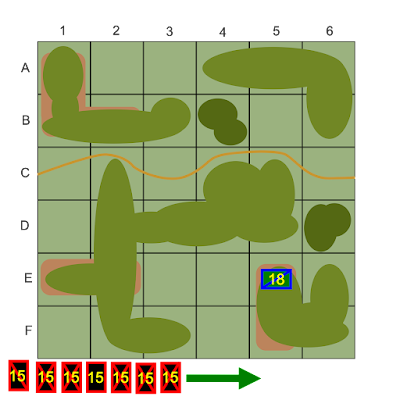
The battle is taking place in the middle of an extensive forest with a poor road cutting through it. This road runs from a C class town in Westonia (Nuevo) to a C class town in Eastonia (Tierwelt). Imagine a road cutting through the North American wilderness in the 1750s from a British frontier town to a French frontier town and you have a pretty good idea of what I was envisioning.

Because the hex was forest with road, and all surrounding hexes were the same, or just forest without a road, I decided to use the same card system for terrain generation, but with some changes. Draw one playing card for each square of the grid (there are six rows of six columns, so 36 cells) and there would be a 50% chance (any Red card) of the square containing light woods, a 25% chance (Spades) of being clear of terrain, and a 25% chance (Clubs) of having special terrain. If special terrain was indicated draw another card and that indicated if it were light wooded hills (the second card being Red) or a heavy woods (the second card being Black). Once you have determined the terrain for each square, draw a road in a logical place from West (left) to East. Here was the board generated.

Battle Plans

The Westonians have two basic battle plans that I can see.

  1. Push through as quickly as possible, trying to exit off of the East side of the board. (50%)
  2. Exploit the gaps in the woods (C1, C3, C6, and D1) to deploy troops and destroy the Westonians. (50%)

The Westonians will use battle plan #2.

The Eastonians have two basic battle plans.

  1. Ignore the minor victory objective (moving troops off of the board) and fight as hard as possible in inflicting damage on the ambushed troops. (50%)
  2. Attempt to obtain a minor victory. (50%)
    1. Attempt to get just the small Mounted Skirmisher unit off of the West road. (50%)
    2. Attempt to get both units off of the West road. (50%)

The Eastonians will use battle plan #1.

Deployment

The Westonians will enter the board at C1 and are trying to get off the board at C6. That said, there is no requirement for the Westonians to exit the board during the battle. As the Eastonians can ambush the enemy they are not allowed to setup in rows B, C, or D, but can set up in any column in rows A, E, and F.

The Westonians will be marching on the board (BG Don NoSeLasTraga prefers to put his Cavalry in the rearguard, not the vanguard). Their forces are unaware of the Eastonian presence, so they must advance down the road at one square per turn until at least one Eastonian unit reveals itself.

Artillery, Infantry and Cavalry on roads may move through woods squares, but because they cannot deploy into that terrain, they are limited in what they can while in those squares. Infantry may only fire from squares that are clear of woods terrain (light or heavy). Cavalry may only charge from squares clear of terrain if the target of the charge is also in clear terrain, and all squares moved through are clear terrain. Artillery may fire from clear terrain to any other square as long as they have line of sight from the center of their square to the center of the target square. Artillery may always fire on an adjacent square that they are facing, even if they are on a road going through the woods.

Deployment for the Westonians is a march column, with three Infantry units in the lead, followed by the Artillery, followed by two Infantry, and the Cavalry unit bringing up the rear. The first Westonian unit will enter C1 on turn 1.

The only stipulation to Eastonian deployment is that they not be deployed in rows B, C, or D (red striped area) and that it not be a square visible from C1. Once the Westonians take their first turn, however, the Eastonians may move to any square.

Because of the Eastonian battle plan, all three light cavalry companies have decided to form into a single, over strength unit.

Conditions, Stratagems, Minor Objectives, and a Twist

For this game I am mainly relying upon the scenario to determine victory. The Westonians win by being able to exit the East (right) side of the board (via the road). The Eastonians win by preventing that.

However, the Eastonians can obtain a minor victory by exiting a unit off of the West side of the board (via the road) before all of the Westonian units exit off of the East side (or are destroyed). If the Eastonians obtain this minor victory not only will the Westonians be forced to spend one day regrouping after the ambush (if there are any casualties), but they will require one additional day chasing down the Eastonians, driving them back down the road Eastward as the Eastonians will be disrupting their communication and supply lines.

Previously I experimented with the Kings of War Battlefield Cards, but also the Warcry Battleplan Cards. This game I will use both.

Because the Condition cards are so powerful, I decide that there is only 25% chance of there being a Condition (drawing a Heart from a card deck). There wasn't.

The Stratagem cards drawn were Sudden Faith for Westonia, and Advanced Scouting for Eastonia. Sudden Faith allows one unit to get a die roll modifier to a Nerve test. See the Thoughts on Changes to One-Hour Wargames (below) on how this might be incorporated. Advanced Scouting only applies to normal games in which troops deploy forces. As this game has specialized deployment rules as it is, this simply means that the Eastonian troops are hidden and their location is indicated on a map until they are revealed. (Not much of an advantage in a solo game!)

The Objective cards for both sides were appropriate only for games in which both sides are attempting to command the field of battle. As this scenario does not fit that model, they are ignored.

The Twist card is Battle Frenzy. The description is as follows: "A killing madness has enveloped the combatants, and they hack and hew at one another in a frenzy of blades and blood." This is an interesting card for two reasons: 1) I was considering whether the Westonians should be allowed to become desperate given that they cannot fire when jammed in march column in the woods; and 2) when I started developing this scenario – an ambush in the wilderness on a poor road – I immediately envisioned the painting of Braddock's Defeat.

Also, Bushy Run comes to mind but in that story the Highlander's desperate charge lead the British to victory.

Because I drew this card, I need to allow the Infantry a chance to fight their way out, despite the Horse & Musket rules for OHW forbidding it. Because of the Battle Frenzy card, I will allow all units (except Artillery) to charge into close combat with the following modifications:

  • Cavalry charging units in the open do so using the procedure indicated in the main rules.
  • Infantry may charge the enemy in the open or light woods, but do so inflicting D6 - 2 hits. If the enemy unit  are Skirmishers or Mounted Skirmishers, they will retreat one square to their rear, otherwise the attacking Infantry must retreat if they did not destroy the enemy unit. If the enemy retreats or is destroyed, the Infantry take the square.
  • Cavalry may not charge the enemy in light or heavy woods.
  • Skirmishers may charge the enemy in any terrain other than impassable terrain. Mounted Skirmishers may charge the enemy in any terrain other than impassable or heavy woods terrain. Both unit types inflict D6 hits, but must retreat if they did not destroy the enemy unit.
  • Skirmishers and Mounted Skirmishers do not get half casualties in close combat, although Cavalry continues to get that benefit.

All the scenario modifiers are done, so now it is time to play the battle. But first…

Thoughts on Changes to One-Hour Wargames

I have been trawling through the various blogs and forums of late, looking at how others have been tweaking OHW. Although I have previously stated my desire not to do that, I have committed probably one of the larger tweaks out there: converting this freeform movement game to a 6", one unit per square, grid-based game.

So what are some of the things I have seen out there?

Skirmishers

I noticed that MarkusB of the Wargamer's Block blog has been putting out a number of OHW-related posts. His post on changes he would make to OHW combat has a lengthy bit on Skirmishers. The three major changes he suggests are: 1) enemy units fired upon by Skirmishers cannot reduce their hits due to cover; 2) fire from Infantry and Artillery are halved; and close combat hits from Cavalry are doubled.

The shift in the power dynamic between Infantry and Skirmishers would definitely shift. Currently, Skirmishers in the open firing at Infantry in a town inflict D6-2 hits, halved (rounding up). The return fire from the Infantry is D6. So this is an average of 1 hit per turn versus 3.5 hits per turn. Under MarkusB's proposal it would be 1.67 hits per turn versus 2 hits per turn.

Note that Skirmishers shooting at one another are D6-2, not D6-2 halved. 

Hussars, Cossacks, Chasseurs a Cheval, etc.

I all honesty, no one else is talking about this; it is me. These are basically alternate names for Mounted Skirmishers. Mounted Skirmishers move 12" (maybe it should be 15"), can move through most of the terrain that Skirmishers can move through, and can fire (d6-2).

In light of the Skirmisher changes proposed by MarkusB, which of those should be carried over to Mounted Skirmishers?

First, I do not see Mounted Skirmishers as Sharpshooters, which is the justification behind Skirmisher fire negating cover benefits.

I do see their dispersed formation and lower unit size as justification to grant them half casualties from Infantry and Artillery fire.

The biggest question I have always had is whether Mounted Skirmishers should have any capability to enter close combat. I cannot see them being allowed to charge Infantry or Cavalry, but what about Artillery, Skirmishers, and other Mounted Skirmishers? My inclination to the latter question is "yes". I could see giving them D6 in close combat, but not halved casualties against hits caused by Cavalry (or Mounted Skirmishers).

Activation Tests

This is one I have seen mentioned in Facebook groups and is often also called a morale test. The most common version I have read is to force a unit to roll dice each turn to determine whether it acts or not, whether than be moving or firing. I have read about both rolling against hits and against remaining hits. Given that I use understrength units in my games, I like the idea of rolling against remaining hits.

An example system might be to roll 3D6 each turn and if the roll is equal to or lower than the remaining number of hits in the unit, the unit can act this turn, otherwise it cannot. Note that in this system a roll of 16, 17, or 18 would mean that a fully strength unit could not act, satisfying those players that want that 'combat friction/fog of war/chaos factor' in their game. Also note that a unit with only 1 or 2 remaining hits would never be able to act. For those that believe a unit is perfectly functional, even with a few casualties, you could use 2D6, meaning your unit is immune from effects if it has 13 or more hits remaining. You could also go to a 1D12 or 1D20, so a unit would never not be able to act (if it rolled lucky enough).

Rolling against hits, rather than remaining hits, can get a bit tricker if you use units with hit values other than 15 as then you would need to track the number of hits lost and the number of hits remaining. Logically, you would also be saying that a unit that started at, say, 12 hits has the same morale as a unit starting at 15 hits. I personally think that as units get smaller in relation to other units, their morale tends to go down too.

Resolving Combat

There have been several proposals to changing the combat system while not messing with the odds that Neil Thomas uses. The first one I saw was Kaptain Kobold's Five Hits System.

Units roll one, two or three dice when firing, corresponding to 1D6-2, 1D6 and 1D6+2. Each score of 4 or more is a hit. Units can take 5 hits.

Then came John Acar's Three Hits and Six Hits Systems.

Six Hits System: We can have each die hit on a 3+ instead of a 4+.  Each unit will take 6 hits.  With this you can match more closely the hit rates of the original rules.  Thus 1D6 (.67) will take 9 hits to kill a unit.  2D6 (1.33) will take 5 turns to kill a unit.  3D6 (2) will take 3 turns to kill a unit.  You can simply double or halve damage as necessary.  Round fractions up as per the rules.  It occurred to me that instead of halving the damage you could simply change the hit number to 5+ for half damage.  Double damage becomes more problematic though.  You are still doubling numbers…which is fine but perhaps slightly cumbersome.  If you like this system, you can simply use a single D6 per unit to track damage and still apply the rest of the rules as is.

Three Hits System: So, a normal chance to hit is now 5+.  Each unit can take 3 hits.  So, 1D6 (.33) still kills a unit in 9 turns.  2D6 (.67) still kills a unit in 5 turns.  3D6 (1) kills a unit in 3 turns.  Now for the cleanup.  If the rules call for half damage, simply halve the probability to hit.  So half damage is the same amount of dice but hits are on a 6 only.  If the rules call for double damage, hits will occur on a 3+.  With this system, you only need two kinds of colored markers.  Yellow, for example, represents 1 hit and red represents 2 hits.  The third hit removes the unit of course.  This system will provide the greatest degree of uncertainty.

I am fairly certain I tried the Three Hits System, but I cannot find the battle report. As John points out, what these systems do is create more chaos and less certainty, which is another way of saying that the combat will be more luck-driven. By reducing the number of die rolls, each die roll becomes that much more critical. As it is there are not that many die rolls in OHW, so reducing them to even fewer seems like you are swapping … what? … for using fewer dice to mark your hits? (By the way, I now use dice to mark remaining hits, given units can start with more or less than the standard 15 hits.)

MarkusB suggested another method (Same Chaos Variant), which I have seen with other rules, but not seen suggested for OHW.

You’ll need four types of tokens, labelled “4”, “6”, “8” and “x2”. Every time you attack an unit, put a token corresponding to the maximum damage that attack could do. So an 1d6-2 attack on the flank would put a “4” token stacked with a “x2” token on the damaged unit. Every time you acquire a new token, tally the total of potential hits so far. Only if and when the total potential hits reach or surpass 15 (or the number of hits the unit has, for understrength and overstrength units), roll all of the dice corresponding to tokens. If those ‘actual’ rolled hits a total 15 or more, the unit is destroyed. If you roll a lower number, the unit is still fine – but it still keeps all the tokens it acquired so far.

I like this method as definitely increases the 'fog of war' by not defining precisely when a unit will break while at the same time not reducing the number of die rolls.

Changing the Turn Sequence

In the same post cited above MarkusB proposes changing the turn sequence from Movement → Firing → Close Combat → Unit Elimination to Firing → Movement → Close Combat → Unit Elimination. Essentially Movement and Firing switch positions in the sequence.

The complaint, and thus the justification for the change, is that you cannot coordinate actions between units with the current sequence. For example, you cannot fire with your Artillery or supporting Infantry while your Cavalry charges as the charge move will generally block line of fire to the enemy unit, or you may have ruled that a unit cannot fire on an enemy unit in close combat.

By conducting fire first, units will have clear line of fire as charging units will not have moved yet, so it allows for units to double up on the enemy, which is pretty powerful. The following images show the difference. The left image shows that, because the Cavalry moves first, the Artillery's fire will be blocked. The right image reverses the order in the turn sequence, so the Artillery will be able to fire before Cavalry can move.

The net effect of this, of course, is that it allows units to double up on the enemy. So is this a good thing or a bad thing? Also, is it a realistic thing?

One of the complaints agains OHW is whether or not each period feels different from the next. I think it does, but do wonder whether sub-periods within the larger period have enough feel. For example, the Seven Year's War and the Napoleonic Wars both fall within the Horse & Musket period, but should their battles feel the same? Obviously I don't think so as I wrote my own AWI Variant for OHW.

If you look at other game designs, such as Richard Borg's Command & Colors (CC) series, the big difference you will see between Command & Colors: Napoleonics (CCN) and Command & Colors: Tricorne (CCT) is the use of a Combined Arms mechanic that the former has, but the latter does not.

The rules for CCN state that, for combined arms combat "When an ordered infantry or cavalry unit is about to attack an enemy unit in melee, one or more ordered artillery units may combine their battle dice with the attacking unit. A combined arms combat must be declared before any battle dice are rolled." Changing the turn sequence in OHW would allow that sort of tactic to be replicated.

Another tactic in CCN is to threaten an Infantry unit with a Cavalry unit, forcing it to make a decision on whether it should form square, and if it does, to hit the Infantry unit with Artillery or Infantry fire. Although this is harder to replicate in OHW – especially if you are not using the optional Square rules – it would be very hard in the current turn sequence unless you are approaching the enemy from two directions, i.e. going after different faces of the enemy unit.

For me, the question of whether this change should be made is centered around time. I used to think that if a unit moved and the other unit did not, then the moving unit should be penalized because it was not spending its full time shooting whereas the other unit was. Sort of a "volume of fire over time" concept. When you realized that many of these rules have turns representing anywhere from 30 minutes to one hour you can't rightly assume that the non-moving unit is actually firing the entire time. If you have ever played the fascinating, but exceedingly tedious Chef de Bataillon (CdB) by Scotty Bowden and Jim Getz you know that the idea of battles lasting hours could not have meant that troops were firing two-three rounds per minute for very long. You would run out of your 60 rounds in 20-30 minutes, not even one game turn. (In CbD, turns were much shorter, however, as they were trying to use realistic time and ground scales, hence the tedious nature of the game.)

So, is allowing a unit to fire effectively – represented by the full D6 of hits they inflict in a turn – and allow another unit to make a full move distance charge all in the same turn realistic? Probably, because much of combat is "hurry up and wait". Most games use non-charging rates of movement as units did not quick march all over the field constantly. There was a lot of wasted time reordering the troops, dressing the line, waiting for orders to be delivered by signal or messenger, etc.

A better way to think of combat is a lot of waiting with short bursts of furious action. By changing this turn sequence you would be implicitly saying that units can coordinate their actions in a single turn.

The question to my mind remains: at what point in time should this effect start to occur? Certainly by the time of the Napoleonic Wars, but not at the time of the American War of Independence, according to Richard Borg. That would split the Horse & Musket period and maybe that is what it needs. Maybe that is one more thing that the rules need to get a better period feel. (Squares are another. I do not allow troops before the Napoleonic Wars to form square. Certainly by the Rifle & Saber period, in Europe, they had stopped. In the Colonial wars it was less a "wall of steel" defensive formation against cavalry and more of a "stop from being surrounded" defensive formation against superior numbers.)

Changing the Range of Horse & Musket Firepower

Another suggestion by MarkusB is to change Infantry shooting range and firepower from 1D6 for 12" to 1D6+2 for 3" and 1D6-2 for 12", the idea being that their deadly firepower is really only at very short range, otherwise it is terrible.

I think if I wanted to simulate that I would grant Infantry the ability to go into close combat with Infantry, and consider that the short range firefight. You could also use the old Ancients and Medieval rules of units in close combat cannot move, accurately simulating the pinning effect of the inability to get unstuck when you are in a hot firefight. That would also grant you the 1D6+2 for that close combat roll. The one change would be that a unit turning to flank while 'contacted' by the enemy would not get to fire on the turn it moves. (If you get flanked and contacted by Infantry, you deserve what you get.)

Secondly, I don't think I would adopt 1D6-2 for normal shooting. If anything, I would probably drop the range to 6". But at this time I think that is too much of a change. I look forward to reading MarkusB's battle reports on how it went. (Hint, hint.)

Enfilade Fire

I've seen mention of enfilade fire before, essentially a unit firing down the length of a unit in march column or down the line (flank) of a deployed unit. Basically the effect is to increase the damage inflicted on the unit being enfiladed.

To me, the farther a unit is away, the less likely the enfilade fire will have must effect. Also, I only consider massed fire as gaining an advantage. If I were using the 'Infantry Firefight' rule above I would only allow it to count if attacking from a flank, i.e. the double effect of a flank attack in close combat would be called 'enfilading fire'.

For Artillery I would allow it better firepower if it could claim enfilade. I would allow enfilade if firing at: an Infantry unit is in square; an Infantry or Cavalry unit is on a road moving through terrain that it cannot normally move through, e.g. woods, marsh, etc.; and the flank face of an Infantry or Cavalry unit in terrain that it can normally move through, e.g. it is deployed into line. I will leave it to you – like Neil Thomas does – to determine exactly what angle it is a flank face or not. Oh, and what should the bonus be? I would grant Artillery 1D6, not 1D6-2 x2.

March Column

A march column essentially grants a unit the ability to move faster on the battlefield in exchange for being exceedingly more susceptible to damage by enemy fire and close combat. A unit commander generally will not risk entering into this formation unless they believe they are out of the dangers of combat, i.e. out of the line of sight or range of enemy attacks. That said, a unit commander will use that formation if they need to move faster on the battlefield, such as shifting a position behind their own lines.

As mentioned previously, a march column can be inferred is a unit is currently on a road moving through terrain that it normally cannot move through, such as Infantry or Cavalry moving through woods. You can either always consider moving Artillery to be in march column or not. (I tend towards not.)

One way to model the unit commander choosing to use march column is if the unit starts and ends their movement outside of 12" from all Infantry, Cavalry, Skirmisher, and Mounted Skirmisher units and outside of all line of sight or 48" (if in line of sight) of Artillery.

The benefit of a march column move is that it provides +6" (one square) of additional movement.

I'll Pause Here

I intended to include the battle report for The Ambush on the Forest Road here in this post, but decided that it is getting too lengthy. Look for the battle report (and the rule changes to OHW that I am going to experiment with) on my Solo Battles blog.

Painting Update: Marvel United

Our group continues to play Marvel United once a week. (Actually, I was able to sneak in an extra game as my wife and I went to a friend's house, and his wife seeing that my wife was playing, decided to learn the game too.) This continues to motivate me to paint more villains (red band on the base) for us to fight and more heroes (blue band on the base) for us to use, keeping the game fresh.

We start with Doctor Octopus for the Spiderverse and part of the Sinister Six expansion. He is destructive to the game's locations, which is an interesting twist for a villain. We have fought him several times on Easy Mode and always won. I had fun painting him, but this was the second attempt on painting the tentacles. I wanted to get a 'shiny metal' look without using metallic paints. (In fact, the only time I use metallic paints is on the base.)

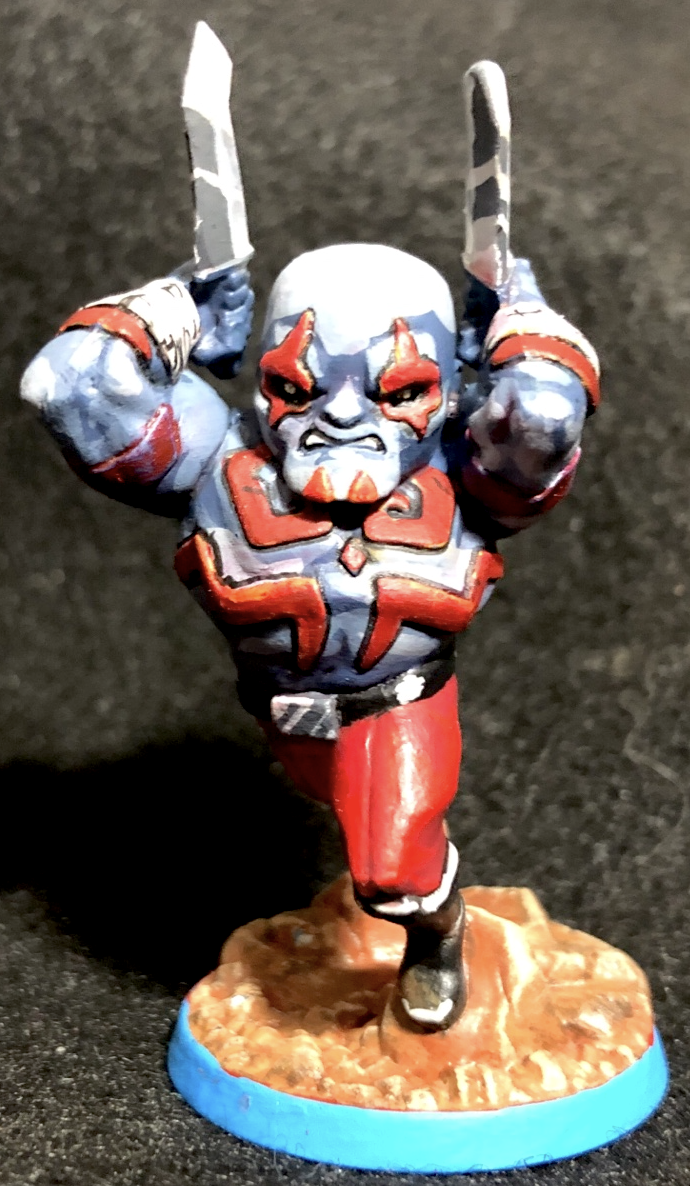
Next up is Drax the Destroyer from Guardians of the Galaxy. Interestingly, the skin color scheme for him was what you see, which is different from the green tint they used in the movie. I wasn't too happy with my painting efforts here, but he looks good on the table.

Next is Kraven the Hunter, also from the Spiderverse and one of the Sinister Six expansion. I just finished painting him, so we have not fought against him yet. Again, this color comes from the game; his hair was black in the comics.


Next up is Moon Knight. He was a request from one of the players. I need to clean up his cape a bit as the shadows look too ragged to my eye. I like how the moss turned out on the stone pillar he is standing on though.


Next is Sandman, from the Spiderverse and the Sinister Six expansion. The sand was contrast paint with dry brushing on top. I really like how he turned out. He is tough as an opponent as he gains health as the game goes on, but we still managed to beat him.

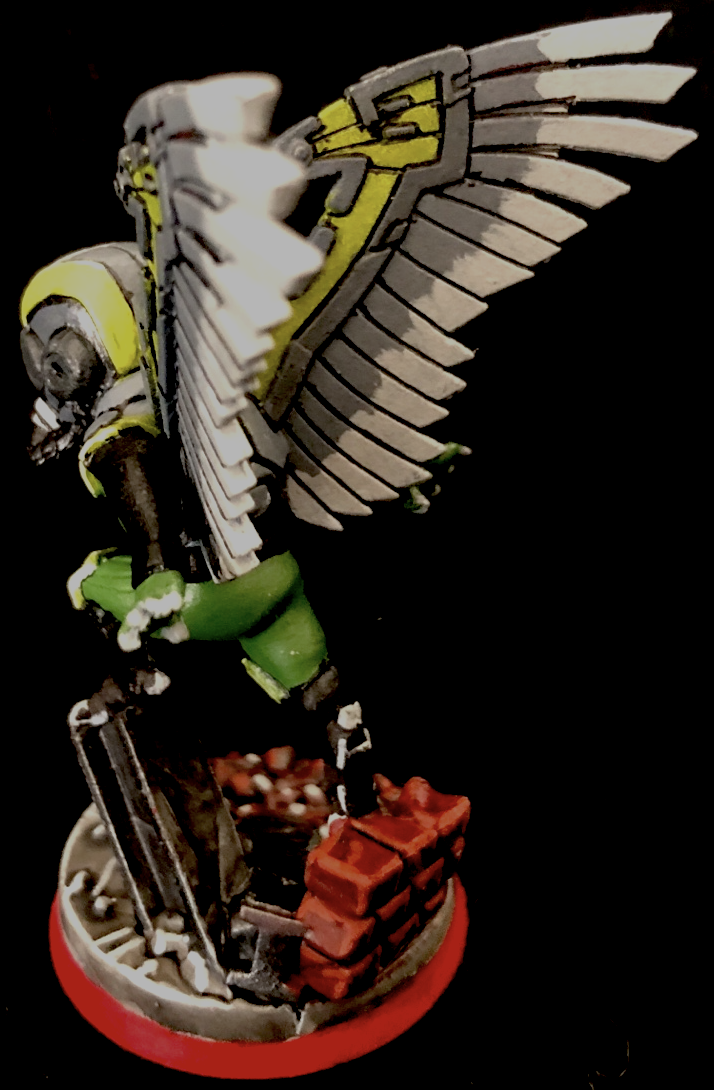
Next is the Vulture, from the Spiderverse and the Sinister Six expansion. He is obviously the new 'model' as the one when I was a kid (in the 1960s) was an old, bald-headed guy in a green suit that eventually got cancer. In Marvel United he is, for some reason, exceedingly tough. You cannot go after him with just any team of heroes as you will lose horribly, as we did four times in a row. He has yet to be beaten. (I need to paint some more heroes in order to have the right combination of movement and healing to defeat him.)


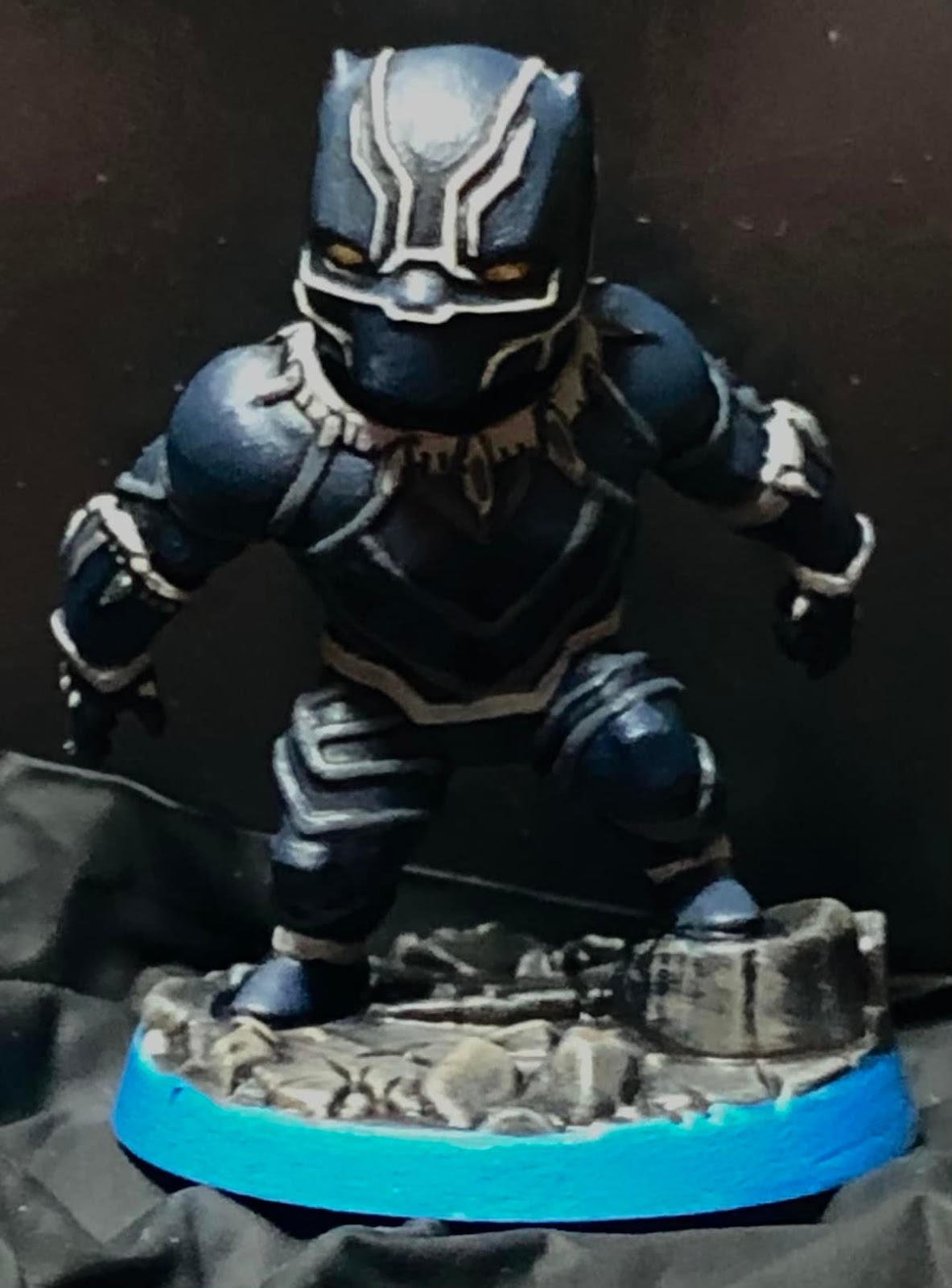
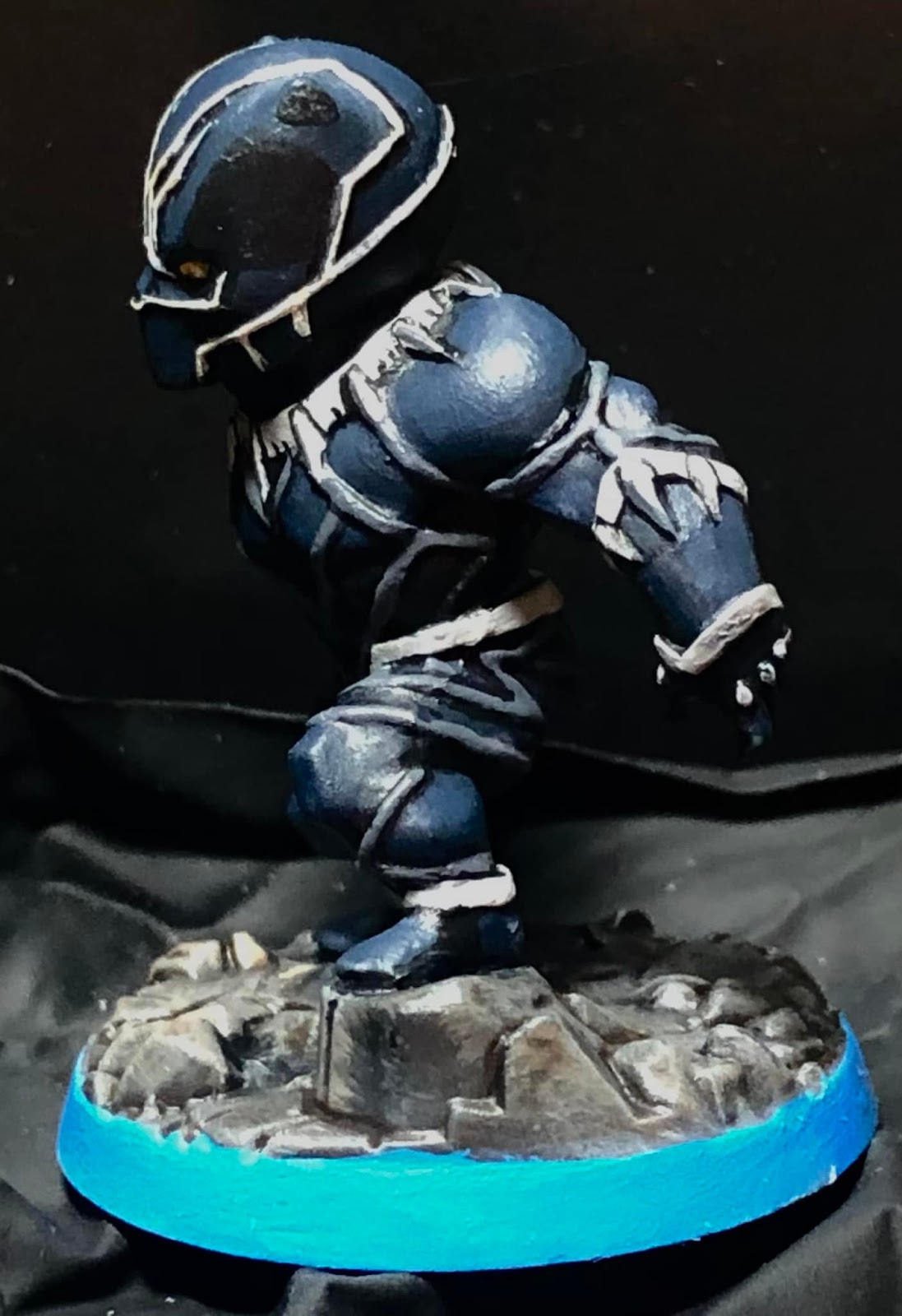
Next is Black Panther, also a request from a player. I wanted to trying a blue-black style for his black suit, but I think it ended up way too blue. I like it though. All those little white and gray lines were a pain though.


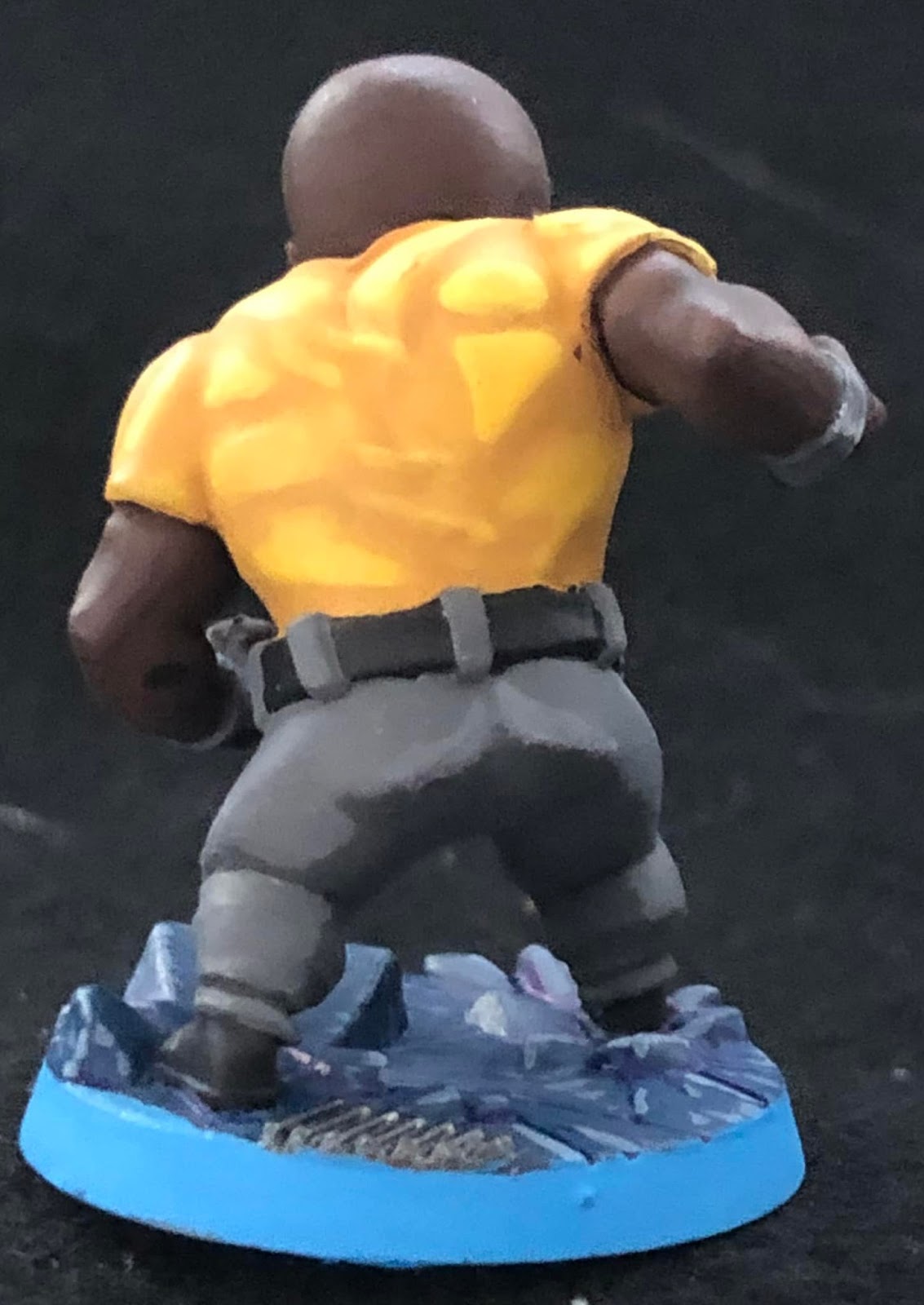
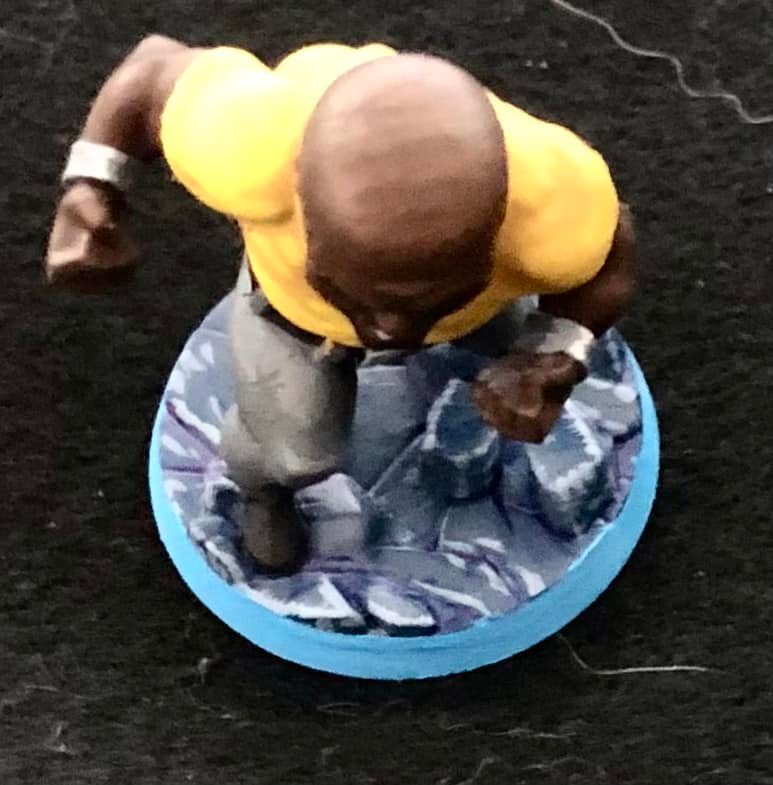
Last is Luke Cage. I painted him for two reasons: 1) I saw a painting video on how to get good yellows by first underpainting with pink, and I wanted to try it (it worked); and 2) I wanted to try and paint the wrinkly effect on a bald head, and he had one (it worked). I think I also did well with the Borderlands cel style using high contrast colors (three shades of yellow and three of gray) with no blending, just hard lines. You can see that in the other figures, like the wings of the Vulture, the suit of Black Panther, and the tentacles of Doctor Octopus.


Blog Archive

Blog and Forum Pages

Popular Posts

Followers

About Me

My photo
Huachuca City, Arizona, United States
I am 58 yrs old now. I bought a house in Huachuca City, AZ working for a software company for the last three years. To while away the hours I like to wargame -- with wooden, lead, and sometimes paper miniatures -- usually solo. Although I am a 'rules junkie', I almost always use rules of my own (I like to build upon others' ideas, but it seems like there is always something "missing" or "wrong").