My blog about my wargaming activities. I collect a lot of 15mm miniatures for the American War of Independence and so collect a lot of rules for this period. I started miniatures with Napoleonics, so I have a number of armies in 6mm and 15mm figures for skirmishing. I have15mm WW II figures that I use for Flames of War, Memoir '44, and someday, Poor Bloody Infantry. Finally there is my on-again, off-again relationship with paper soldiers that I sometimes write about.

Showing posts with label news. Show all posts

Thursday, October 27, 2022

News and Such

Face-to-Face Gaming

Fistful of Lead

As you saw with the last blog post, I recently tried out the rules A Fistful of Lead (Reloaded), which focuses on the Old West. Although I made a hash of the rules I have since purchased A Fistful of Lead Core Rules and Fistful of Lead Fantasy: Might & Melee. The Reloaded rules are an abbreviated/simpler version of the Core Rules and does not have all of the options and nuances available to the player that the latter two do. Honestly, the differences in the core mechanics are so small, especially viewed in terms of increased page count, one wonders why Reloaded stripped them away. I hope to try these rules again with gaming buddy Bill.

Brigade Fire & Fury

I am part of a Facebook gaming group dedicated to gaming in the SE section of the state and I have always noticed that one person was always posting about the terrain boards he was making and the figures he was painting – ACW, Napoleonics, and Napoleonic-era Age of Sail – just massive amounts of work. He would invite people to come to his house and join in, but he rarely got a response. I asked him where he was and he told me a place out in the middle of nowhere about 2 1/2 hours away. (Hey, this is SE Arizona. We are all practically out in the middle of nowhere!) His games were on Friday nights at 6 PM and I could just never make it. With three hours of prep and driving that would mean I would need to leave at 3 PM. That was possible when I was working but then there would be the gaming of at least two to three hours, then another 3 hours getting back. I was thinking that would be about midnight before getting back, after a (partial) day of work. It just sounded too taxing. Now that I am retired, I decided to give it a try, only I decided to stay in a cheap motel and make the drive back the next morning.

First off, it is a nice drive there, not too bad. I drove through the city of Tucson between lunch hour and rush hour so traffic was not too bad. On the way back I took a different route (not the interstate) and it was a very nice change (for desert terrain).

The game played was a pseudo-Gettysburg battle oriented towards learning the Brigade Fire & Fury (BFF). The host is building a 12' by 6' game board for playing Gettysburg in Warlord's Epic ACW scale, which I believe is 12.5 mm. He wants to play Gettysburg soon and this was a dry run of sorts. He is also building a Waterloo game board and the corresponding forces for that. His collection was truly daunting.

It has been some time since I have read the Age of Eagles rules, the Napoleonic variant of BFF, but I slowly got the hang of the rules as the turns rolled by. As you can see from the image below, it was a fairly sizable game. We (the Union) "won" but that was because we substantially outnumbered the Confederates and our rolls to move were definitely better, so we reached the objective (the central ridge) first, forcing the enemy to charge uphill to dislodge us.

At some point the host will finish up his painting and the game board and he will do another dry run of the game. If I do it again I will have to be sure that I get a better hotel room as this game lasted four hours and my back was killing me reaching across this 6' deep board and I needed a much softer bed!

Still More Marvel United

Our Marvel United games are still chugging along every Monday night. I lost one player to pickle ball and Middle Earth Strategy Battle Game but picked up another so we still have four to six players each game night.

Here is the Loki figure that I painted. Not a powerful villain, but still interesting.

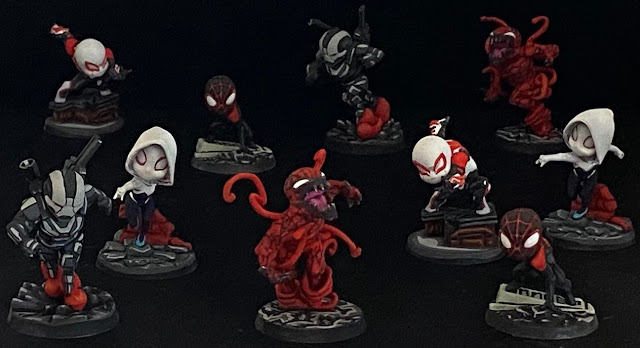
I also commissioned Spiderman 2099, Miles Morales, War Machine, Spider Ghost, and Carnage, plus a few others not in this picture to be painted by Smooth Blend Studio and I think they turned out very well. The X-Men core set is being worked on right now.

Playing Around with Laser-cut Base Designs

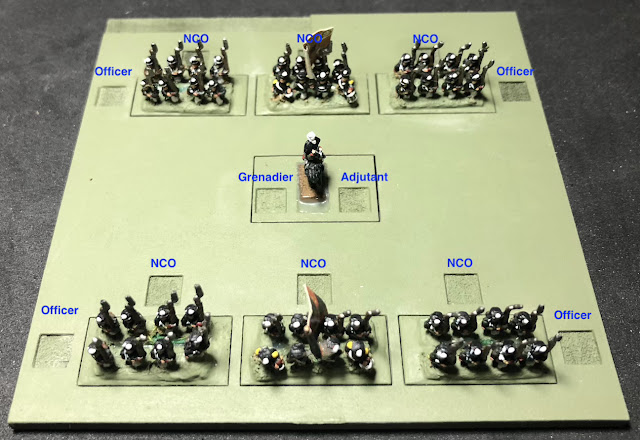
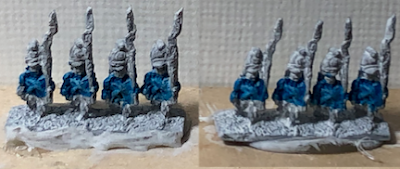
I have been playing around with multi-use base designs again. Right now I am working on my 6mm Napoleonics whereby each group of figured is mounted on a 1" by ½" base which slots into a large 4" wide base for use in One-Hour Wargames. I intend to add additional figures as decorations to the base. As you can see in the image below, I will place line officers at the ends of each unit, NCOs behind them, and a general and his staff in the center of the base.

Russian Napoleonic Infantry 'Brigade'

If I were doing more of these units I think I would decrease the depth of the base so there is less empty ground between the two units and probably put the command staff at the rear.

The space showing in the upper left corner (which is actually the lower right corner when the base is facing away from you) would be were a label, specific to the rules you are using, would be affixed.

When I bought the rules Men of Bronze from Osprey I thought to myself "do I want to paint up a new set of figures (I have them in a lead pile) or do I want to take my huge DBA collection and rebase it?" I was thinking along the lines of something like this.


The idea is that I would base each figure separately, on a small base (white rectangles with a red line). When playing DBA (upper left and upper right) the number of figures per base and the base dimensions (gray rectangle with black line) would be correct. But I could then pull the individual figures out and slot them into larger individual bases (lower left) and use them for other systems.

The one catch in all of this is that one set of figures I would really like to use with this basing scheme have a beautiful basing scheme. The idea of destroying that for something lesser I would do is hard to contemplate right now.

I have been thinking about doing the same sort of scheme with my 15mm AWI figures. Currently some are based 2-3 figures on 40mm by 20mm bases, single figures on ½" square bases, and single figures on metal washers (of at least two different sizes). This scheme is sort of a 'cake and eat it too' dream.

That said, I may get rid of these figures...

My Wooden Soldiers

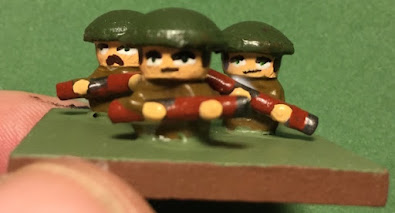
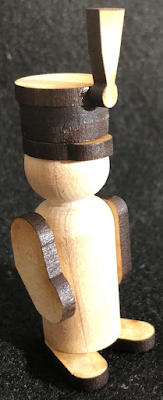
I have always enjoyed making my wooden soldiers. I have heard people say "that takes too long", but once you've assembled multi-part plastic models, scraped off their mould lines, and filled in the gaps you realize that making minimalist figures like mine is actually quicker. Also, having no cast details means you can paint only those details you want freehand, so it goes much quicker.

WWII British Infantry

Every time I bring out my wooden figures, or post them in battle reports, people always remark on them. I once played in a DBA tournament with handmade wooden figures and no one refused to play against me because 'they aren't real miniatures' as I imagined they might.

I know one of the things that has stopped me from selling many of my miniatures has been that I don't want to 'lose capability', i.e. not be able to play a genre or specific ruleset because I sold my miniatures. I also find myself trying to find rules to use because I have painted miniatures and the ones they were originally painted for have fallen out of favor. (WWII and Flames of War comes to mind. I like Hail of Fire, but they keep changing because the author comes up with great new ideas.)

So my new plan is to make and paint new miniatures for the collections that I have – maybe not so many this time – and then when it is replaced with wood, sell off the metal and plastic. (It is going to be hard to part with my beautifully painted Thracians though. I may keep them just for display.)

What do you think?

Scale75 Instant Colors

As those who have read this blog for a while know I have been experimenting with Citadel Contrast Paints, Army Painter Speedpaints, and transparent acrylic inks, washes, and paints. The idea is to paint a figure white, or primer black and then dry brush gray and white to highlight (now called the 'slap chop' method), before putting on the transparent colors. I like this style but have struggled with the various products.

To date, Citadel has been the winner, but as I watch more videos I have come to realize that the manufacturer's advice on how to use all of these products – one thick coat – is not the way to really use it. Better to use thinner coats and allow the dark and light of the undercoat show this. (Called 'value sketching'.)

There are several other competing products out there, mostly because Citadel's Contrast Paints have been so wildly successful, but I have not tried them. Green Stuff World's Dipping Inks, the upcoming Express Colors from Vallejo, and Scale75's Instant Colors have all been avoided, until now.

When I saw the first videos of Instant Colors – on Scale75's YouTube channel no less – I thought the results looked absolutely horrendous. Blotchy and pale. For some reason a video popped into my feed about 'underpainting and Instant Colors' and because I am always interested to see what color people use to underpaint with – such as underpainting with pink if the color will be yellow – I decided to watch it. I was actually amazed that the final product was so good and he used Instant Colors. So I went out to a hobby shop and bought one set (8 paints for $50) to give it a try.

What I found is that you need to treat these like paints, i.e. use thin coats and not thick ones like the manufacturer suggests. Unlike Speedpaints (and many Contrast Paints) which are very saturated with one coat, Instant Colors increases saturation as you lay down more coats. The figure below shows what I mean.

One Coat Two Coats Three Coats

Okay, they fewer the coats, the blotchier it is, but seriously, the above looks like they came from three different bottles of paint. Further, because they act as filters due to their transparency, if you use different colors on top of one another, you effectively make new colors without mixing. This document provides a really good example of what each Instant Color looks like over a specific color of primer. This has been my second most serious complaint about Speedpaints; they are too saturated and you have to thin with expensive medium to desaturate it. With Instant Colors it looks like it would be much easier to replicate the desaturated color palette from pre-industrial dyes. (That is a good resource for what colors to really use, by the way.)

So, as this is more the way I like to paint now, white base with transparent colors, followed by blacklining with inks to separate colors, Instant Colors not providing a strong contrast actually works better for me. (I went out and immediately bought a second set to test.) It will be interesting to see how this plays out on wooden figures.

Well, that is it for now. Next time, an update on one of my favorite rules, Tin Soldiers in Action and a report from a convention I will be attending. (Unfortunately not Fall-In 2022.)

Saturday, July 30, 2022

More Painting, More Thoughts on Downsizing, Goodbye My Friend

I have been doing a lot of painting of late, as part of my trying to figure out which scales to keep and which to shed.

Wooden Warriors – French (Napoleonic) Marine of the Imperial Guard

One only my Wooden Warriors blog I finally made two posts. The first was about how to use my laser cutter for something other than making paint racks and wooden bases; I decided to take a different approach to making Napoleonics shakos. I did a test and then painted up this French Marine of the Imperial Old Guard.


6mm Napoleonics Painted with Citadel Contrast Paint

Someone on one of the Facebook groups had asked about whether anyone had tried painting 6mm miniatures with Citadel Contrast Paint. As I had done some 15mm in the past, I decided to give it a go and report on the results. I decided to try a harder subject that the standard Space Marines or Space Elves; I went with Napoleonic-era Bavarian troops.

First a couple of notes. Firstly, 6mm closeups always look horrible; they just do. You really find out how shaky your hands are when you photograph 6mm troops. You can actually see details, flaws really, that you just don't see when you are looking at them about 1' away (or farther).

I started by priming the miniatures white with Pro-Acryl white primer. It is a nice, thin white that does not clog the detail, which is important with 6mm, especially if you are going to use Contrast Paints or Speedpaint. As there are older Baccus sculpts, they are very rough and thus will take these types of paints well.

Here is what they look like, fully painted. (I later took a little more white to the trousers and cross belts to make them more solid.)


Overall I was good with the results, but I really need to look at the results of figures that are more crisp. The older Baccus sculpts are very 'rough' and I was not keen on them. But I love the newer sculpts. Also, using the gray Contrast Paint as a replacement for metallic paint is not really a good idea, so I would change that and go back to a gunmetal color.

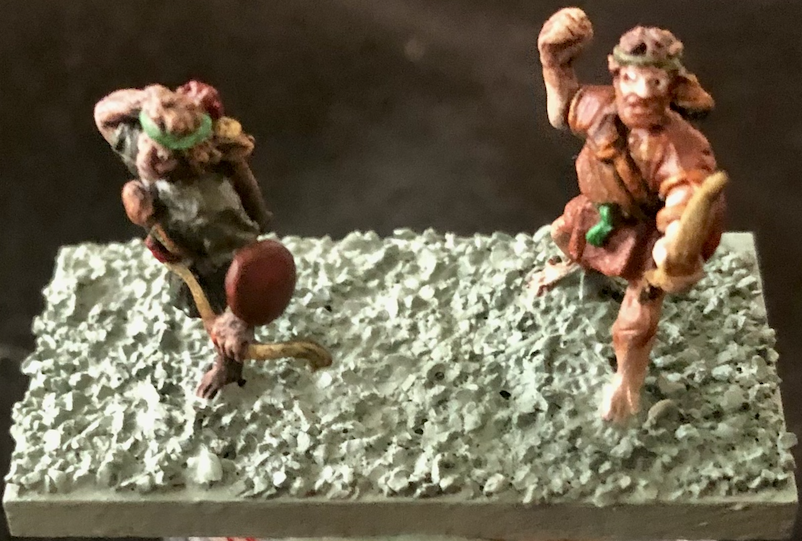
Next up are Xyston 15mm Later Achmaemenid Persians. I bought a ton of Xyston 15mm ancients when Brookhurst Hobbies had a clearance sale and I have had them heaped in a pile of shame every since. (Greek Hoplite and Thracians are two of the armies that I vowed I would have a large collection on, one day. They would practically all be Xyston miniatures too.)

I started off airbrushing on a Zenithal primer. I started with Pro-Acryl black and fully covered the miniature. Then I swapped in Pro-Acryl white primer without cleaning the pot, knowing that it would come out gray. I liberally covered the figures, leaving only the undersides untouched. Finally I drybrushed white on top to pick up the highlights. 


Next I started carefully laying down the contrast colors, doing white touchups for areas where a darker color was laid down over an area where a lighter color was intended.


Here are the final results. For the most part I had to use light, opaque highlights over the areas with Contrast Paints to remove the 'tide pools' and 'coffee stains'. The newer Contrast Paints that have less contrast, such as the bright yellow on the purple and yellow figures, as opposed to the yellow-brown on the other figures. The former did not require yellow highlights (I actually shaded with Shade Paints), while the latter definitely did.


Overall I think the older Contrast Paints are too 'brutal' for 15mm. It is better to go with a base color and use Shade Paint or a wash to collect in the recesses. If you want three colors go with a base color as a mid-tone, highlight with a lighter color (use more contrast between the base and the highlight than you would with 28mm figures), and then wash with a darker color. The tint from the wash will tone down the mid-tone and highlight, bringing down the contrast, and match well with the shadow color it gives the recesses. For me, Contrast Paints do not seem to be the solution for 15mm. It flows too well for the scale.


The last experiment came from watching a video by Bunker6. He paints a lot of Games Workshop Epic Warhammer 40,000 figures – roughly 6mm – and he puts a lot of detail into them. I decided to see if I still had my eye and hand (because if not, the unpainted 6mm were going to be on the chopping block).

I started with the new Imperial Fist Yellow Contrast Paint because: 1) these are meant to be Imperial Fists; 2) I don't have any other yellow that is that exact hue; and 3) these are supposed to be one of the new single pigment colors that cover well and are low contrast (which is ironic for a 'contrast paint'). First off, it does cover well and the flow characteristics are generally nice, but the smaller the scale the less you want your paints to flow. As this was my base coat for the model, and nothing was going to be a lighter color, I did not care that it flowed off of the areas where I put the brush. If anything, it ensured that I did not miss a spot.

Personally I think I put in a little too much detail, but nonetheless I went forward with the exercise because I wanted to see whether the effort was wasted or not. I already consider this picture too zoomed in for tabletop view, but not so close that it looks closer than bent arm's length (the range most people generally use when they pick up a stand to look at it). I can still see the attempt at details, like the grey behind the knees (rubber parts in the armor), the black stripe on the helmet, the red glowing eyes, and the black and silver bolt gun. I can also see one other detail that you probably don't see and that is only because I intentionally painted it: I painted a yellow highlight color and a yellow shade color. Is it worth it? Not sure. But I answered my question: I can still paint 6mm troops to an acceptable table standard with my eyes and hand.

A Note About Army Painter Speedpaint

My experiments with Army Painter Speedpaint has been disappointing. Largely because they are not really acrylic paints, but some form of 'resin' paint. Water causes them to reactivate, so adding acrylic highlights over them causes them to partially blend with the color being painted on while also popping the color off of the primer, exposing the white (or whatever the primer color was) below. Not a good effect because you cannot really control it. Dana Howl (YouTuber miniature painter) was the first that I saw that suggested the way to deal with this was to mix your acrylic paint with either Speedpaint Medium or another Speedpaint color, effectively turning it into a custom Speedpaint color. A lot of people must be doing this because Speedpaint Medium is very hard to find right now and where you can find it, it is double its normal price.

One thing I have found out for sure is to not mix Speedpaint with acrylic mediums like matte medium, glaze medium, metallic medium, etc. It makes it into a gloppy mess that spreads even worse than Speedpaint, that Flow Aid or water does not seem to fix.

At this point I see Speedpaint as an 'all or nothing' solution.

Sad News

More than 15 years ago, while still trying to build a gaming club in Sierra Vista, Arizona, I was searching The Miniatures Page for players who might be within driving range, but were to the east (i.e. we were closer than Tucson, Arizona) and thus underserved, gaming-wise. I found Marv and Betsy Schmid and despite them being five hours away (in Deming, New Mexico) they said that they would be happy to hop in their camper and come to Sierra Vista and teach us this game called De Bellis Antiquitatus (a.k.a. DBA). They had numerous armies and all the terrain we would need. It was a smashing success, such that many of us started collecting DBA armies. It also led to the discovery of HOTT, me creating American War of Independence version of DBA (DB-AWI 2008) and HOTT (HOTR 2009), and even a blog (now inactive) about my DBA games.

Over the years my wife Rita and I have alternated visiting with Marv and Betsy, us going to their house or they coming to ours. Gaming buddy Don and I once dropped by on the way to a DBA tournament in Albuquerque, New Mexico for inspiration and last minute tips. We even went to a state park with a lake together to swim, camp, and game.

Part of what I have been doing of late is re-connecting with people that I haven't spoken to during the lockdowns, especially those that are not in my immediate area. That has led to some great conversations with people across the country and around the world, but sometimes it leads to sad news. It took finding an old mobile phone, recharging it, and retrieving the phone number I failed to transfer over to my new phone to finally reconnect to Marv and Betsy, only to find out that Marv had died last May of brain cancer.

Needless to say, Betsy is still trying to cope with the loss, but Marv had a large wargaming collection and she was trying to get a hold of me in hopes that I would take it off her hands. Right when I am trying to downsize my own collection… So, right after I retire next month I am going to head to Deming to inventory his collection, see what I think I can "move to a good home", i.e. what is sellable, and work with her on managing the sale of his collection. Hopefully I can sell things off on Facebook, The Miniatures Page, Fanaticus, and eBay and send her checks periodically. I know it will be a lot of work, but it is a bit of repayment to a couple that showed us a part of this great, fragmented hobby that ended up being a big part of my wargaming experience (and this blog), plus it will show me how to reduce my own collection.

In a way this is something I have been considering, and although it is a bit morbid, it is something we need to consider. What will happen to your collection when you pass? Are you sure the kids will take it? Are you sure your friends will? Do they know they are going to be tagged to disposed of your collection? Is your wife expecting to recover some of the costs of your hobby? Does she know that you "invested" in a depreciating asset? Does she know who to contact about your collection? Does she know how to sell it? Does she know a reasonable price? (Do you? When was the last time you sold?)

I posted a message on a DBA forum on Facebook to try and get a sense of what the market for painted 15mm DBA armies is. Ten years ago I used to scour eBay, Fanaticus, and TMP for painted DBA armies and paid what I felt was a premium buying them. But I stopped playing DBA after 3.0 fragmented the player base. Like Flames of War 3rd and 4th Editions, I just couldn't get into the next edition, despite buying the new rules. I was done. And with that exit went my knowledge of how viable the market was.

Fortunately, it appears that the market is still good. Not only are people still playing DBA 2.2, 2.2+, and 3.0, there is a new derivative called Triumph, but it appears that Art de la Guerra (ADLG) using the standard DBA basing. So I feel better about taking on his DBA collection to sell for her. His WW II and Arab-Israeli micro armor, however, jet age Check Your 6 aircraft collection, however, are a different story. But just like the old joke about how to eat an elephant (one bite at a time), so to with how to move someone's lifelong collection. Enough whining!

Here's to you Marv. You will be missed.


Monday, July 04, 2022

Personal News, Wargaming Thoughts, and Some Painting

 Personal News

Let's get this one out of the way. First off, I am retiring in about six weeks. I am 60 years old (and I turn 61 in October) and although I planned on retiring October 2023, circumstances force me to retire early.

I am a computer programmer by trade (in the U.S. home mortgage software market – talk about niche) and I have always said that I could probably continue on even if my hands went, because there is such good voice recognition technology out there, but if my mind ever went, I was done for. I used to be known for my attention to detail, but lately I have not been able to focus. I am easily distracted. Worse, I don't just forget where I left off at, I forget that I was not finished with a task and my mind tells me I was.

This apparently happened pretty quickly. My company awarded me a huge bonus and raise last January for being a top performer in the company (Zillow); now I can't remember to complete a task.

I knew it last Tuesday when I was in a Root Cause Analysis (RCA) meeting – otherwise known as a "who screwed up" meeting – and someone was showing a result from my application and I knew it could not "have happened". The previous day I had changed the code at their request and there were three dates in the change. My documentation (rare for a programmer) noted all three changes. The comments in the code noted all three changes and the change number that ordered it. And the code was changed … in two places. I must have gotten an email, chat message, or phone call and by the time I was done, did not remember that I had not finished. But it was not just forgetting; it was my mind being sure that I was done. Not a single thought of "oh, I have to check to ensure I finished that".

Lest you think I give up easily you have to understand that this was simply the last event in a long line of them that I was not admitting to. In fact, I was started to even hide them. I would blame this or that for why things went wrong, but the reality is that it was me.

I called my brother (four years older) because I remember him saying about six months ago that he had been diagnosed with something, and I wanted to be sure what it was. He has Parkinson's. We talked about it and I am pretty sure I do not have that. I have none of the motor skill symptoms. Also, mine is not a feeling of forgetfulness. I am not one of those people always saying "now what was that I was trying to remember?" It does happen on occasion, but my problem is more an arrogant assurance that I have remembered something – like finishing a task – or not even thinking to do something.

So, I decided that I did not want to go from 2021's top performer to 2022's guy that we want to get rid of. I want to be able to leave with a little dignity rather than milk the job for every last dollar until they feel like they have to fire me.

Fortunately, I have been a lifelong saver and I married a woman more frugal than I am, so I can afford to drift the remainder of this year and all of next year. I can pull sufficient money out next year from my retirement fund (we call it a 401(k) in the U.S.) and draw on Social Security at 62, if I want.

So What is Next?

I decided to give my company four weeks, so that I could transition my work and archive of code to a new person on the team. If they get someone in to replace me, all the better, but I have pretty specialized skills. It took them nearly a year to find me.

My manager reminded me that Zillow pays out its bonuses partially every quarter and that if I wait an additional two weeks that means I accrue about 500 more shares of Zillow stock (which declines in value every day), so I decided to wait for that. I am already leaving a lot of money on the table, but no need to rush out that quickly.

After that I need to head to a neurologist and figure out what is going on. My brother, who is a research scientist (his specialty is mosquitoes and pesticides) thinks we were poisoned as kids (Florida was famous for spraying residential neighborhoods with "safe" pesticides in the 1960s and 1970s), so hopefully it is something treatable for me.

If not, well that I why I want to leave the workforce now. I want to spend the rest of my time doing all of those things that I always told myself I would do "when I finally retire". I am going to paint and game, of course, continue doing more blogging, but also travel more. The wife and I are looking at using AirBnB to visit various places in Panama, for example.

Another project is to get rid of old games and junk that have accumulated that I just know I will never get to again. We all go sometime and the last thing I want to do is burden my wife or the kids with having to get rid of "the crazy old man's toys". Not that I think I will get any money back for it. More that I would like to see it go into someone's hands that would us it. (One of my gaming buddies did the same to me about three years ago, giving me all his Spanish Civil War 15mm troops that he knew he would never get to. I never got to it either.)

Multiple Scales and Multiple Genres

Which leads me to this topic. I have long been pondering getting rid of some miniature collections. But which ones? I rarely considered, when looking at shiny new figures to buy, whether I had all of the necessary accessories to go with those figures. Largely I mean terrain. Sure, there are some things that work across periods, like hills and trees, but building, other structures, even roads can very much be period specific. (It is funny how many times I use roads with 15mm scale tank treads showing for roads in my 15mm Ancients and AWI games, and as foot paths in my 42mm Dark Ages games.)

What scales should I keep? (I have collections in 6-8mm, 15-18mm, 25-28mm, 32mm, and 42mm, with a few, rare pieces in 2mm, 3mm, 10mm, 20mm, 1/72nd, and 54mm.) What genres should I keep? (I have collections in … uh, never mind.)

I always thought about having one (smaller) scale for mass battles and one (larger) scale for skirmish games. But that is still potentially two sets of terrain. Here are the conclusions I came to so far.

6-8mm: I like this scale for one reason, and that is because I now have a tendency to play games on smaller areas, like 20" x 30", 2' x 2' and 3' x 3'. Figures that are 6-8mm work great for this size table. There are just two problems: 1) my eyes are failing so painting them is hard; and 2) I find it very hard to identify what the troops are, especially if I try and use 'realistic' basing with flocking, sand, etc. Some of the best terrain I have for this scale are old Monopoly houses and hotels, which you can buy very cheaply on eBay.

15-18mm: I have a lot of troops and terrain in this scale. The largest collection is probably Ancients/Dark Ages/Medieval, but they are in DBA-army size groups, i.e. about 12 stands per 'army'. Second is AWI and third is WWII. Terrain is largely for WWII. (My terrain for DBA was always flat felt or foam rubber because no one used realistic terrain, as it got in the way of game play.) The ability to paint this is better than 6mm and I can recognize troops better. I keep telling myself that this is what I will focus on.

25-28mm: For me this is the nostalgia scale. I started miniature gaming with 25mm Napoleonics. I still have miniatures that I painted back in the 1970s and 1980s, plus too many old (valuable) Citadel miniatures from the 1980s and 1990s. What I do not have anymore, is terrain. Further, the little terrain I do have is Space Gothic. (You know what I am talking about.) This scale is very paintable, vision-wise, but due to their larger surface area it takes more time. Also, manufacturers are cramming the details on these things. Finally, if you decide to go with this scale, storage of miniatures, and especially terrain, starts to become an issue. On the positive side, other people are more likely to be using this scale. (But I generally provide both sides anyway.) Also, there is the question of whether I can play anything other than skirmish games at this scale if I do not have a 6' x 4' board.

On a side note, Marvel United is basically somewhere around this scale (or 32mm), but I consider it an exception to the 'keep or dump' decision. Unlike traditional miniatures, the figures in Marvel United are very much tokens for a board game and thus the idea that you need terrain for them isn't true. So, I will keep these as they neither fall in the skirmish or mass category for tabletop wargaming. One might include all miniatures from board games, in which the terrain issue doesn't exist, in this same sort of category. That would mean my Star Wars figures from Imperial Assault could be kept.

32mm: Although the new figures from Games Workshop might fall into this category, for me it was Star Wars: Legions. As a rule set it is definitely something I no longer play, nor will pick back up, so these are a definite candidate of figures to clear out.

42mm: The only miniatures that fall into this category are my wooden soldiers that I make. I have a Napoleonic and Dark Ages collection, along with appropriately scaled trees, but not much else in the way of terrain. Felt always works for roads, rivers, plowed fields, etc. As long as I stay away from structures, I am good. Ironically, I have found it easy to play skirmish games with these figures, but mass battles require a 6' x 4' table. I tend to use smaller unit sizes (6 figures or so) anyway I tend not to put a lot of figures on the table. The largest hassle with this scale is the larger surface area requires more paint and time, with a tendency to want to add detail as it is so visible.

I know one of the first tasks once I retire will be to get rid of all my 32mm Star Wars Legion troops, followed by the 28mm Bolt Action, Warhammer, and Warhammer 40,000 figures, both painted and unpainted. If I get rid of all of those, I may not have to make the decision between 15mm and 6mm. The 6mm collection is actually pretty small, physically. Also, there are some incomplete line in my 15mm collection to get rid of like the Marlburians, Polish 17th Century, Renaissance WoFun figures (experiment that failed), and even Napoleonics (my 6mm Napoleonics collection is far larger and more consistent).

My goal is truly not to buy any more.

Recent Painting Videos

As part of my resolve to move away from 25mm to 32mm figures strengthens I realize that I need to either paint or sell all of the 15mm figures that I already have. I have a number of random AWI figures that need treatment, plus have a number of WWII troops from the Flames of War days to be painted, but by far the largest collection is unpainted Ancients. I remember Brookhurst Hobbies had a 50+% sale on Xyston Miniatures – and I love those sculpts – and I purchased a couple hundred dollars worth at sale prices. Maybe 100+ packs? Some insane amount. I have a whole 33 liter/35 quart storage tub filled with these packs. (I admit temporary insanity.)

Nonetheless, I saw a painting video using Army Painter's Speedpaint – which I bought as soon as it became available, in order to give it a try – for historical miniatures and I decided to give them another try.

My initial complaint with Speedpaints is that it was too blotchy, like Citadel's contrast paints. Added to that the paint reactivation issue that Youtubers talked about and it seemed like it was off to a bad start. I gave them another shot anyway and I must say that I think they work better for 15mm because there are no large, flat surface areas (unless you are paining vehicles), so you just don't see the problems. As for reactivation, well I just make sure I seal them with a spray varnish rather than a brush-on one. The one thing I do know is that they do not like traditional acrylic mediums and flow improvers. I would also use a separate set of paint brushes with them (as I do with Citadel contrast paint, India inks, acrylic inks, varnishes, and gesso).


Recently I have been watching more painting videos about all kinds of subjects. One came in my feed from an artist named Warhipster, whom I had never watched before, and he talked about why Citadel contrast paints produce blotches, pools, and stains, and how to use them properly. I swear, if all you do is watch the opening sequence you will see someone paint the smoothest finish with contrast paint I have ever seen, all without dilution or mediums.

It was this video that had me break out the contrast paints once again. Of course, just when I do that Citadel decides to increase the size of their line of contrast paints and have changed their Shades line to use contrast paint formulation, so they are weaker (wash) versions of contrast paint. It makes sense because washes and contrast basically do the same thing, which is appear stronger in the cracks and crevices and weaker everywhere else. With washes (Shade) we just want that tint to be as weak as possible while still maintaining sufficient color strength in the cracks. The bad part about the new line: I hear it will cost $195 to buy all of the new contrast paints. (I am not even sure that includes the new shades.)

I have lots of Arcadia Quest chibi-style figures to paint (in addition to my Marvel United figures). I painted this monk up with contrast paints and shades in very short order.

I started by priming him bright white rather than the typical black then white zenithal. I spent some time inking him with a black micron pen before sealing it with varnish (so the ink would not reactivate from the solvents in the contrast paints). At that point I was ready to color the figure, much like the process in old school comic books (draw, ink, then color). You can see the blotchiness of the colors – I clearly need to watch the video above again, and practice more – but I think the overall effect is acceptable, especially given the time it took to get the figures on the table.

In addition to all of this I reconnected with Matt, my co-author on the Wooden Warriors blog, to see how things are faring with him. (Things are fine, but he finally caught Covid after dodging it for more than a year of teaching classes.) Neither of us have made a post there (I hope to rectify that soon), so I wondered whether he dropped out of the hobby or whether he was simply not making figures anymore. It turns out he has revived his interest in old board games, like Heroquest, and had obtained a set and was merrily painting away. He told me about a Spanish YouTuber living in Malaysia and his channel Rush the Wash. His technique to is zenithal prime and then use contrast paints to get his figures out on the table quickly. (Previously he white primed and used Citadel shades, glazes, and inks – the latter two some very old products – to paint his figures.) Ironically, this was a style I had been trying to accomplish for a long time. A long time ago – we are talking late 1980s here – I used to paint a number of things with Higgins, Windsor & Newton, and Bombay India inks. These days it seems like few places, other than online art supply stores, carry a decent range of colors, so I drifted away from it. However, I purchased a DBA army or three from Timurilank in the Netherlands and I saw that he had a transparent color glaze look to his figures – you can see an example in the first picture of this post on his blog – that I have been trying to replicate for awhile. Rush the Wash was all about that style. Also, you can find videos from a few others on the "slap chop" painting style, but I think that is less distinct. I think my 15mm ancients, above, reflect that style, only without the gloss varnish.

More Marvel United

We have been playing a lot more of this board game, both as a group, face-to-face, and virtually using Tabletop Simulator. The former games give me more incentive to paint my miniatures while the latter allows me to play a campaign with other people around the country.

Here is what I completed on my painting table. First up is Silver Surfer. We played him once and he was powerful, almost too powerful to play against anything but the strongest villains (like Thanos).


Because he comes pre-paint in this chrome silver, all I did was add black ink lines to define him further, and paint the space-y base.

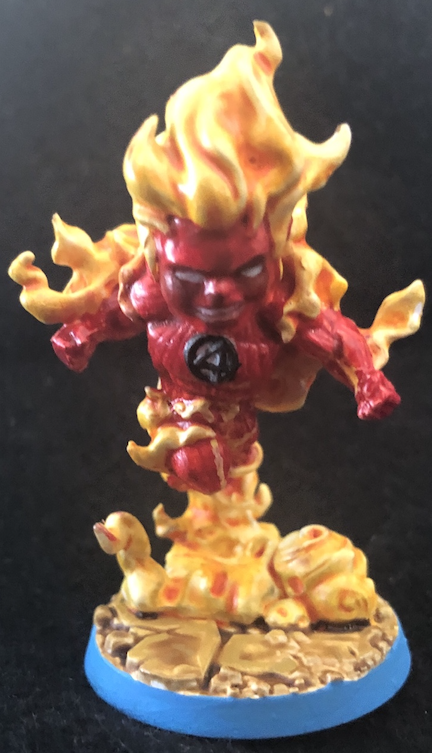
I decided that the first set from the Marvel United X-Men series that I wanted to paint was the Fantastic Four expansion. So I started with the Human Torch. He comes cast in an ugly transparent orange plastic, so I primed him white and used Pro-Acryl transparent red acrylic paint and Bombay crimson India ink for the body, and Pro-Acryl transparent yellow and orange acrylic paints and Bombay yellow and orange India inks for the flames. The base is contrast paint and Pro-Acryl acrylic paints for the highlights and base rim. The only thing I might add is thickening the black to outline the eyes.


In order to try and keep my "one new figure painted a week" schedule I decided to tackle The Thing next. He is contrast paint for the body with acrylic paint highlights. The shorts are Pro-Acryl blue transparent acrylic paints with acrylic paint highlights and the belt is all acrylic paints.


Last up is the villain Killmonger. On one hand I wanted to try a new technique, but on the other I was reluctant to use a different technique than I used for all of my other heroes and villains. This was a black prime with white zenithal and heavy use of contrast paints, shades, and transparent acrylic paints. There is very little opaque acrylic paint used, and it was only used for the highlights.


One of my gaming buddies is the person behind Smooth Blend Studio and is the one who painted many of my Warhammer Underworlds figures, plus the Guardians of the Galaxy expansion for Marvel United. He has opened up his schedule to paint 30 more figures for Marvel United, so expect to see more in the coming three months.

Monday, January 25, 2021

I Received My Dream Tool: A Laser

This was long overdue, but as I head towards retirement (three more years) I decided it was time to stop procrastinating and to buy a dream tool that I had been pondering for a long time: a laser cutter and engraver. Now you might be wondering why this is on this particular blog and the answer is because it will absolutely play a role in cutting out parts for my wooden warriors.

In the past I used a Cricut cutting machine to cut out arm shapes and Spanish bicornes from craft foam sheet and, although I liked the flexibility of the material, I did not like how it took paint. With a laser I will easily be able to cut out shapes in 3mm and 1/8" thickness.

Right now I am in the experimental phase. I have long drawn images for wargaming using various drawing packages on the Macintosh. I bought the Glowforge Plus and it accepts SVG format files as input for 2D work, i.e. cutting and scoring. I have been using Inkscape for years, and that saves in many of the formats that the Glowforge accepts.

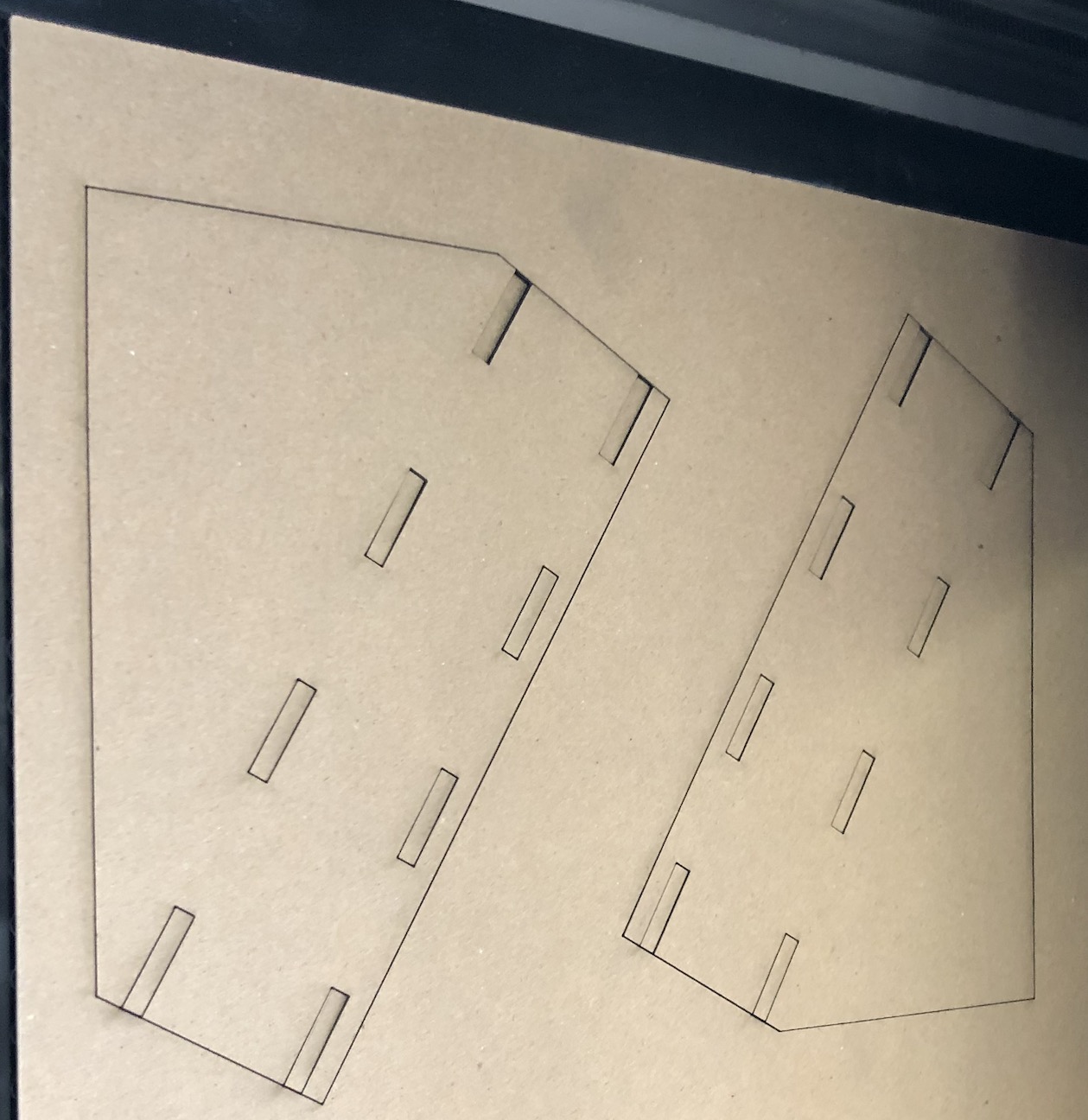
My first experiment was creating a painting rack for my paints. I use Pro Acryl mostly right now and they have a large bottle size than the craft paints and the Vallejo/Army Painter sized bottles, so I thought I would cut out my own as an initial project.

I looked at other paint holders and I noticed that many have the paint bottles standing straight up and down. The better ones stack one on top of another. I didn't really want that kind. I wanted the bottles angled and showing the color as much as possible.

The top plate of the holder has holes slightly larger than the bottle's diameter (30mm) so the paint bottle can slide in comfortably.

I decided to cut out two of these sheets so I could double up on the sides and make it stiffer.

The bottom has small holes so the bottle's tip could slide in.

I really like how I can see all the colors so easily. It takes up a bit of space, but I don't want stackable holders where I have to unstack them to remove a paint bottle and I am tired of having to pick up bottles to look at the color from holders where the bottles stand straight. If I were afraid of the bottles leaking I could still reverse them (tips up) and see the colors while being able to easily grab the bottle.

This was a really instructive project and I look forward to doing more. Right now all of my projects are more wargame accessories and the like. I generally don't like markers and tokens on the table, but use them in battle reports. Arrows to show movement or retreat, X to show combat or unit elimination, etc. I used to cut them from craft foam. Now I can draw up anything and have it cut from cardboard.

Thursday, March 02, 2017

Third Time's the Charm

Twice I started to write a post and twice I threw them away because they did not feel right. If you are reading this then the third time's the charm.

Guilford Courthouse

I have played the Guilford Courthouse scenario from the Rebellion supplement of Black Powder twice now and it continues to stymie game play. The victory conditions in that scenario require the British to break more American 'key' brigades than they have by the end of the game. The only key brigades for the Americans are the two Continental brigades (Williams and Huger) – which is appropriate – while the British have three key brigades (i.e. all of the British brigades). What this means in game terms is that the American militia brigades (Eaton, Butler, Lawson, and Stevens) are 'speed bumps'. Any losses on these brigades have no effect on American victory conditions.

Guilford Courthouse map from Rebellion
So the goal of the British is to carve through the first two American lines while taking a minimum of losses.

For the Americans, there are three basic strategies:
  1. Let each American line take on the British one at a time, inflicting as much damage as possible, but delaying the collapse of each line as long as possible. (This is what Greene did historically.)
  2. Rush the American second line (Lawson and Stevens) to the forward woods line before the first line collapses, denying the British a toehold into the woods before it engages the American second line.
  3. Rush the American second and third lines to the woods, ensuring that the American always maintain numerical and firepower superiority at the point of contact.
The first time I played the scenario (as the Americans), I used strategy #1. The result was that Leslie's brigade stalled at the fence line on the right, O'Hara's brigade broke through in the center but stalled at the woodline after destroying Eaton's and Lawson's brigades, and Webster's brigade pushed back the left flank skirmishers (while helping to destroy Eaton's brigade) and made it to the far edge of the woodline when the Continental brigades pounced and destroyed a British regiment, sending them reeling back into the woods. We called the game on time, but the Americans clearly had the upper hand.

There were a number of rules that we got wrong – I still have not completely re-read the Black Powder rules despite playing three games in the last two months – the most prominent being that it is much harder to inflict hits on units in the woods.

The second time we played the scenario the group decided to punish me for the last game so everyone was British, except me. I was the sole American player. This time I wanted to try and bring the game to a conclusion, even if it meant losing. Given that only breaking Huger's or Williams' brigades will risk an American defeat, if you hold them back the entire game, you cannot lose, you can only draw (at worst). This time I went for strategy #3, which would put my precious Continentals at risk, but would bring a large amount of American firepower to bear early in the game.

Leslie's brigade again stalled the entire game, not least because the first order rolled was a 'Blunder', resulting in the Hessian regiment retreating off of the board when Lee's Legion looked at them cross-eyed. (Such are the wildly random results that make up a Black Powder game.) Despite the British Legion cavalry being committed to the right flank to counter Lee's cavalry, Leslie's brigade barely made it to the fenceline by the time we called the game.

O'Hara's brigade deployed to both sides of the road early in the game, unlike the first time, and it looked like sending the Grenadier Guards against Butler's brigade would help rout them early. However, there is a quirk with one scenario rule that I do not think the scenario author anticipated nor intended. The NC militia (Eaton's and Butler's brigades) get to claim the fenceline as a "position" which they defend. There is an obscure rule with regards to brigades breaking and 'defensible positions'. If a brigade breaks from too many units being in Shaken status or being lost, it must automatically retire one move if at the beginning of its turn it finds itself within 12" of an enemy unit. One of the exceptions, however, is if the unit is in a defensible position it is not forced to retire and may stay in place. This means that the NC militia, as long as they stay on the fenceline, they will not retire unless they explicitly fail a Break Test.

So, what is the math behind a Break Test? For infantry, you can pass a Break Test caused from shooting if you roll a '6' or better on 2D6, or a '7' or better on 2D6 if the test was caused from hand-to-hand combat results. There are modifiers, mostly from taking hits or being Disordered, which make the roll much harder. The problem is, that if you make those rolls you can get some pretty spectacular results, like your NC militia brigade routing the British Guard Grenadiers after fighting them to a standstill for three turns in hand-to-hand combat! (The British players at that point were threatening to beat me up and melt my dice because of all my hot rolling.)

By rushing forward both the second and third lines the Americans were able to bring their massive firepower into play, such that Huger's brigade was almost to the fenceline by game's end and Williams' brigade was engaged in hand-to-hand combat with a weakened Guard regiment from O'Hara's brigade in the center.

Again, technically a draw, but clearly had we kept playing the Americans would likely have won a victory.

So what went wrong? Were the stats for the American troops too high in quality? Is the scenario poorly written? Actually, the American troop quality is pretty poor, more than I would have inflicted upon them. Further, the British are practically Supermen, in terms of Black Powder. They are Elite, so they can shake off disorder without losing a turn. They are Steady so they automatically pass the first Break Test. They have a higher than average Stamina, so they last longer before they even need to take a Break Test. They are Ferocious, so they get to reroll their hand-to-hand combat rolls that miss. They are practically 'Gods of War'. The only thing the two Continental Veteran regiments are better at are shooting, and that is only marginally so. The main issue is that the British infantry save from a hit on a 3+ on 1D6, 2+ if they are in woods. So it is very hard to inflict hits on the British. Combine that with an increased number of hits required before it must take a Break Test and it automatically passing the first such Break Test and you have a game where the British do not actually have to roll until you are deep into a game. Conversely, most American units count as Wavering, which means they must roll for a Break Test every time they take a hit.

As for the scenario victory conditions, are think they are actually well thought out. The Americans did not care about militia losses, so allowing the Americans to ignore those brigades breaking is something that many rules fail to recognize (hint: this is an issue with the Guilford Courthouse scenario in Clash for a Continent and Hold the Line). If there is an issue it is that there is one British brigade, Leslie's, that is particularly vulnerable. But that was historical.

The only other issue is the scenario special rule for the NC militia, indicated above. We have decided that if we ever play this scenario again – and I think most people are frustrated by this scenario – we will probably not allow the fences to be considered a 'defensible position' for purposes of the Brigade Break rule. It makes the NC militia way too hard. Without that rule, unless a NC militia regiment, unless locked into hand-to-hand combat, it will automatically retire one move each turn if it is within 12" of an enemy unit. Given that visibility in the woods (most of the board) is 12", this essentially means the NC militia will no longer be in the firefight once their brigade breaks, unless the British charge them.

But these issues were not what made the scenario break. Quite simply, the core command and control mechanics of the Black Powder rules favor a static defense. It is way too easy to flub a command roll and have it throw off your well-laid plans. Now before you go saying "but isn't that historical?" we are not talking about whether chaos exists in a battle, but whether these rules have the appropriate probabilities assigned to account for that chaos. I say "no".

The one issue that I also don't like about the Black Powder rules is that I believe their hit and save probabilities are wrong. The basic chance to inflict a hit with shooting is 50%. You generally roll 3D6 with a standard unit and hit on a 4+. It is very common for that chance to be reduced to a 5+ (33%) and the best you can do is a 3+ (67%). The chance to save from that hit for a standard unit, however, is 50%. That chance rarely goes down, except when hit by artillery fire, but often goes up, such as when the unit is in cover. Further, elite units often have a better save. In the Guilford Courthouse scenario it was very common to require a 4+ or 5+ to hit, but to save the hit the rolls would often be 2+. There is just something fundamentally wrong with your game system when the chance to save from a hit is frequently twice the chance to inflict the hit in the first place. This makes for grueling, frustrating games in which you are essentially looking for a '6' on a hit to stand some chance of actually causing some sort of effect on the enemy that you might exploit. It is this math, which is part of the core mechanics, which make this scenario especially problematic. This scenario is rated for 24 turns, which is unusually long for Black Powder games. For example, in the two scenarios we played, which lasted four hours each, we got maybe 7-10 turns in. This scenario is meant to be played slowly and really requires that you keep the game setup, which is highly ironic given that the historical battle lasted 90 minutes.

So, why do I play Black Powder when I think it is flawed mathematically? Because other people are playing it...

By the way, if you want to see the pictures of the game, both times put on by Leo Barron, you can see them on the Facebook group "Awi Historicals". Sorry, but you have to be a member of Facebook to see them and you have to join the group as it is private. It is a good group though. 
One of the Kickstarters that I got into, that I really did not talk about much, was the Arcadia Quest (AQ)campaign by Cool Minis or Not (CMON). You can find AQ all over the place now, with items for sale on eBay, in hobby shops, and on Amazon.


I bought this game, some extra characters, the extra campaign (Beyond the Grave) and yet never played it. Cool minis in the Chibi style though.


I read the rules and although they looked interesting, they did not really stick in my head. For one reason or another, every time I sat down to give them a try I had to re-read the rules and something happened that stopped me from being able to give them a try.


Well, then out came the Kickstarter campaign for Arcadia Quest – Inferno. I had a feeling I would like AQ once I tried it, so I could not let that campaign slip away, so I bought that too.


That came in and hell, I did not even crack the plastic until a few days ago. More cool minis.


Finally, there was a Kickstarter campaign for Arcadia Quest – Masmorra, which has the same sort of cool minis.


I have cracked the plastic, but when I realized the rules were not the same as the other two – it turns out that it is a dice-driven, dungeon explorer game – I set the game aside. I still had AQ to learn!


Well, in one of those rare moments, my wife offered to play me in a game again. I thought, why not try this (finally)? It might be more up her alley than a military wargame (although she has never complained about them, nor really even cared about the subject matter).

I decided to learn the rules for a third time and actually play out a game solo before playing it with her. That way only one of us would be wondering what the hell was going on.

The backstory for AQ is that humans came along and disrupted the world for the elves and the orcs. After building a great city, Arcadia, the people created and joined adventuring guilds in search of glory and gold. The orcs, led by a vampire, decided to lure the guilds away from Arcadia by filling dungeons full of goodies (sounds like a future expansion...), and once they succeeded they sprung their trap, and attacked and conquered Arcadia. The game is all about the guild members returning to the monster-infested city in an attempt to retake the city while gaining glory and gold for their guilds. The only problem is that the guilds are not completely cooperative.

Each boxed set is an entire campaign with a full narrative. You need AQ as it contains the core rules, but the expansions have new characters, monsters, rules, boards, and scenarios. The idea is to select your characters (three heroes), equip them, and play the scenarios in sequence, collecting gold and treasure, upgrading your heroes and their equipment while rising in level, penetrating deeping into the core of the city.

The board setup is pretty involved, but pretty straightforward. There are plenty of tokens in play, so organizing your table is necessary. You are not going to play this on a 3' square space.

Like most board games distances are regulated by a grid, a square grid in this case. Players reference cards for each of their heroes, each of which list all of the critical stats and special rules. There are also reference cards for each of the monsters.

Basically each hero and monster has a movement speed, hit points, and defense. Monsters have an attack rating also while heroes' attack ratings are defined by equipment, spells, and weapons, which can also modify their defense rating.

Attacks are conducted by rolling the black dice. Each black die has two faces with a Sword, one face with a Bow, one face with a Critical, and two faces that are blank. Your attack rating determines the number of black dice you roll and whether you are looking for Swords or Bows as hits. (Swords are for melee, which means you are in the same or adjacent square to the target, while Bows have unlimited range, but are restricted by line of sight.) Criticals not only provide a hit for either melee or ranged combat, but they further allow you to roll an additional die. If that die gets a Critical it allows an additional die, and so on, i.e. it is an 'exploding die' mechanism.

The defender, in turn, rolls one white die equal to their defense rating. There is one Shield face, one Critical face, and four blank faces. The Shields each cancel one hit. The Criticals also cancel a hit, but like the Critical on the black die, it is an exploding die, so you get to roll an additional die for each Critical.

Very basic and easy to play. All of the combat results are in the dice (love it!) and all of the special rules are on the reference cards in front of you.

Victory conditions are defined in the scenario and generally indicate a number of quests that need to be completed by a player before they can claim victory. Typical quests are to obtain a token on the map (usually guard by a monster), kill X number of monsters, and kill a hero from another guild (another player's hero). So the game is both Player versus Environment (PvE) and Player versus Player (PvP).

After the first player achieves victory, the scenario is over. At that point you turn in the treasure tokens you collected and spend the gold coins you received for killing monsters and completing quests. There is a system of dealing out reward cards that allow you to purchase new upgrades and equipment so that the next scenario you play, you will have more options available to you.

The rules require a little bit of rules reference, at least until you get a little more familiar with the tokens and what they mean, but combat is quickly picked up and completely heads up, i.e. your nose is not stuck in the rules. You will definitely be reading through the between-scenario rules unless you play a lot and frequently. But if you are like me, playing maybe once every one or two weeks, you will likely need a refresher on that section of the rules after each game.

Because this is basically played as a campaign, and not as single, unconnected games, you start to build a narrative with the game, which is the whole point. My goal is to work through all of the scenarios from all of the expansions with the wife. I anticipate that it will be great fun.

Replayability is pretty high because not only do you have a lot of heroes to try (each player only uses three heroes throughout the campaign), but there are multiple scenario paths during the campaign. Add to that there is the randomness of reward card draws, curses from dying, and so on, resulting in a lot of game play before this looks tiring.

I look forward to playing the campaigns and hopefully I can convince the wife to paint the miniatures with me.

Sunday, September 18, 2016

Rules Review: Jabberwocky, Ritter, Fusilier and Ein Ritter Spiel

Last weekend I played the first miniatures game in a long time. Too bad the rules ... sucked. But it did help reinvigorate me to get back into miniatures gaming. I have started painting and crafting again, and of course, obsessing over rebasing my 6mm Napoleonic troops. Part of the problem is deciding over which rules to use, all of which seem to have different basing requirements. More on that another time.

I have been using a set of rules for a while that I have never reviewed before. Not sure why I have not reviewed them. Maybe because they are pretty obscure and are relatively hard to get. Maybe because they will not be everyone's cup of tea. I think they have some interesting ideas, which is why I decided to finally review them.

What is it all about?

Chris Engle of Engle Matrix Games and Hamster Press has been around the gaming world for awhile. If you have ever heard of matrix games, you were probably reading about one of Chris Engle's games. But these rules are not matrix games. Rather, they are the rules that Chris used to fight out the battles that resulted from playing his military campaigns run as matrix games. Here is the history from Chris:
Starting in the late 1980's I began running military campaign games at conventions using a Matrix Game. This allowed players to run whole wars, with a minimum of rules, in under four hours, battles included! Because of this I had to develop miniatures battle rules that would allow players to play a small battle in five minutes and a large battle in fifteen or twenty minutes. A hard standard to meet, but the result is the game presented here.
So, if you are not playing a campaign game, why would you want a set of miniatures battle rules that play the games out in 20 minutes? Well, perhaps one of the reasons why I have not played many campaign games is because the battles themselves take so long to complete that players lose interest well before the campaign completes. In the last two campaigns I played – both using Memoir 44 – it took us at least three gaming sessions of about four hours each to complete each one (and these were published campaigns). There were at least four campaigns in each of the books – so about eight campaigns – and we never even got to the other six because of fatigue.

But that is not why I bought the rules. I saw a copy in some random hobby shop while I was traveling for business somewhere. What caught my eye was the subtitle on the rules: "a diceless battle game for miniatures". The first copy I purchased was Fusilier, which is the third in the Strategic Spectrum Series, and covers the Horse and Musket era. (If you see this title online be careful, as there are several other rules out there with the same name. The odds are great that it is not this game unless it says the author is Chris Engle.)

The first miniatures game I purchased that had diceless combat was The Compleat Brigadier. No one liked them but me. It had you writing order and there was that whole "diceless" thing. Everyone wants to roll dice. There is the physicality of the process and the suspense. But I feel that with some games the rules author clearly weren't paying attention in a couple of their math classes when they were kids. Some of the variations are wild. Some don't roll enough dice in order to try and smooth out the die rolls, resulting in games that are simply die rolling contests. Generally speaking, if you don't roll dice, you pretty much have to have your math correct (or at least, reasonable). So I wanted to check out Chris' ideas and see how he made it work, if at all. Here is some of Chris' rationale for going diceless:
At first I tried to make a game like other miniatures games, with dice and tables. They were not fast enough. It appears that the fastest a dice game can get is thirty minutes, not fast enough. For a long time I could not think of what to do. The it hit me. Why do I need dice? In most games it is pretty obvious who is going to win a fight without rolling a die. I began experimenting and found it works! Not only that but it produces a very fun game that has all of the subtleties of chess while looking pretty as a wargame.
This made sense to me. Why? Because about five years earlier I had come to the same conclusion with role-playing games. Think about it. You are the Game Master and you have built this adventure. You have put in all of these goodies and thought up a story line. Honestly, the last thing you want to have happen is either:
  1. The players run into some enemy group (or worse, a random wandering monster) that was only supposed to be a speed bump, but due to a series of unfortunate events ends up trashing the party.
  2. The players run into something you don't want them to fight (maybe it is the entrance to the next adventure, which you have not completed yet) and after a series of extremely lucky rolls end up trashing your monsters. They then open the door you did not want them to open yet and say "Okay, what next?"
I knew what encounters were fillers, or supposed to provide an item they needed for the next segment of an adventure. I knew when I wanted the players to win and when I wanted them to lose. I knew that Game Masters would, when seeing their design start to go up in smoke, pull out that extra Fireball spell or that potion and suddenly start rolling dice behind the screen and come up with critical hits. Game Masters always had the option to "smooth out" a weird string of dice rolls, so if they could (and would) do that, why bother with the dice? I found a set of rules called Amber (a diceless role-playing game) and used the principles set out there and ran a couple of very successful campaigns using no dice for combat at all. It was actually pretty fun because you essentially had to create a narrative for the combat. But back on point, many situations were simply "pre-determined", so why let dice mess that up?

When it comes to warfare, Chess follows the same mantra. If you can maneuver a piece to a specific position, you automatically take the opposing piece. The combat is a foregone conclusion, so why dice for it?

Fusilier, et al essentially provides a set of conditions that define when an attacking unit forces the defending unit to retreat. Units are destroyed when they retreat into a "killing ground", which is essentially into a friendly or enemy unit or into new terrain. The battle is one of maneuvering units to make conclusive attacks that drive the enemy into killing grounds, destroying them. When enough units are destroyed, the army breaks.

In Fusilier, et al each army is 10 bases strong and has three ratings: Movement, Attack, and Break Point. The Movement rating determines the number of units or groups that may move in a single turn. The Attack rating determines the number of attacks, on single enemy units, that the army may make in a single turn. Finally, the Break Point is the number of units that the army may lose before it breaks in morale. A typical army has a Movement of 2, Attack of 2, and Break Point of 2 (i.e. 20% losses). These numbers may seem really low, but it actually forces the player to focus on only those attacks where they can win, and win strongly.

As a note, the Attack and Break Point ratings are defined as:
  1. Bad troops, poorly led, trained, or equipped.
  2. Average troops, neither inspired nor cowardly.
  3. Good troops, we armed, trained, and led.
  4. Inspired troops, exceptionally led and trained.
  5. God-like troops who are destined by God to win an empire.
For the Movement rating, cavalry armies tend to have at least a 3 with great cavalry armies having a 4. Infantry armies have a rating of 2, with particularly sluggish armies (like Early Greek Hoplite) having a 1.

Movement

The rules Jabberywocky, Ritter, and Fusilier all use free, measured movement; Ein Ritter Spiel was written with a square grid in mind. All use essentially the same system: each unit is a single base and all bases are a standard width. Any grids are one base width in size. Infantry move one base width and cavalry moves two base widths. When units retreat light infantry retreat two base widths, heavy infantry one, and cavalry two. Special units (elephants, monsters in Jabberwocky, heroes, etc.) use some variation of the infantry and cavalry rules.

Maneuvering is where a lot of the differences are in the units. Light Infantry units are the most maneuverable, by far, with everyone else fairly limited to how they can move. Given that this is a game of maneuver, this is the section of the rules that players have to place the most attention. Once you get into a bad position, it is very hard to maneuver out of it.

The Movement rating of the army indicates the number of units or groups that can move. This is very similar to movement in De Bellis Antiquitatus (DBA). If units are grouped together (bases touching and all facing the same direction) then moving that group only uses one Movement point (like a Command PIP in DBA). So grouping units together is very important and as time and the effects of combat and terrain come into play, your forces will fragment into smaller groups, therefore limiting how many units can move each turn.

Terrain has little effect on movement. No "1/2 movement" or -3" type stuff here. You can either move through it or you cannot. I can see adding some extra rules, however, like woods and towns breaking formation, but currently the rules have none.

Combat

Combat is conducted by indicating a unit that is attacking and the units supporting the attack, and the unit being attacked. The players then go down a list of combat results, finding the situation that matches the condition of the attack, and read the combat results (which are almost always "are defeated"). Now I cannot give you the whole combat results lists – that is the intellectual property of Chris Engle and why you buy the game after all – but I can give you a sense of it.
  • Missile unit with two unopposed supporting missile units defeat everyone.
To count as "supporting" a unit must be be able to attack the same target. So if it is melee, they have to be adjacent and facing the target unit; if missile combat they have to be in range, line of fire, and line of sight.

In order to count as "unopposed" the supporting unit cannot be adjacent to an enemy unit other than the target. I had (incorrectly) taken it to mean that a unit would also be opposed if opposite an unengaged enemy missile when using missile combat, and quite liked it that way.

The list of combat results is in a specific order, ranking from most likely to least. For example:
  • All troops defeat troops attacked in the rear or flank.
  • ...
  • All troops defeat civilians.
If a unit of Peasants (civilians) attack a unit of Knights from the rear it wins the combat because the rule "All troops defeat troops attacked in the rear or flank" has higher precedence than the rule "All troops defeat civilians". If the Peasants were attacking from the front it would be a disastrous attack, resulting in their defeat. (Not much of a reason to make that attack then!)

All of the combat results lists are pretty much the same from rule set to rule set; each just provide variations based on the period and genre reflected by the rules. For example, Jabberwocky is a high medieval fantasy rule set so it has to have rules for Monsters, Heroes, Wizards, magic, and flying creatures. Those sorts of rules, however, would not be in Fusilier, which is set in the Horse and Musket era. Those rules, however, would have rules about arquebuses, musketeers (with and without bayonets), and artillery, which Ritter, set in the ancient and medieval times, would not.

All in all the combat works pretty well and you get the hang of the order in the list, so often you don't even need to reference it except in special circumstances. Generally speaking, if your attack has support you will defeat the enemy; if not, it is sort of a rock-paper-scissors drill as to which unit types defeat which enemy under what circumstances.

There are also a number of optional rules, including those who cannot do without their dice. (Throw 2D6 and a '12' means the loser of the combat becomes the winner, a '2' means the combat was a draw, anything else means the results as indicated stand.)

Break Point

This is another area where the rules stand out from most games. Other rules state when the game is won. Players play until the victory conditions are met, which is largely when the enemy breaks in morale. Then they pick up the game, chat, and talk about shoulda' coulda' woulda'. Not in these rules. When you hit the Break Point (remember, an average army will hit that after the loss of two units, or 20% casualties) you then have the choice of fighting on or retreating. In fact, it might be necessary to fight a rearguard action with a few units in order to ensure that the remainder of the army makes it off safely. If you lose units equal to twice your Break Point, your army then goes into Rout state. Everyone then is forced to make a beeline for the board edge.

Why would you want to play out the rout of an army? Remember that these rules are to play out the battles in a larger campaign game. Rather than rolling dice for how many units get swept up in the rout, you actually play it out. It also makes you think about how far you are extending yourself on risky attacks. If the attack fails it could spell the destruction of your whole army as it is scattered across the board. (Remember, you only have a limited number of moves per turn.)

Game Ratings

So, using the review system from before, here are the game ratings for Fusilier, et al.

Drama – do the rules create tension during play?

Not rolling dice does remove some of the drama. Nonetheless, the lack of dice does not remove drama entirely. Chess games can be exciting as they go back and forth. Where the drama comes into play is when your opponent carries out unexpected moves, especially ones that you did not see coming.

These rules rate 3 out of 5 in Drama.

Uncertainty – are there enough elements that introduce uncertainty into the game?

The one thing about deterministic combat is that it squeezes uncertainty out of the game. Uncertainty largely comes from your opponent, and how he uses his army, rather than from dice or other elements of chance. That said, two games exactly the same will not play out exactly the same way because each player's decisions are meaningful. Games with these rules does lower the noise of combats that play no significant role, it discounts them completely. These rules cut to the heart of the action. It is up to the players to find out where that heart is.

These rules rate 2 out of 5 in Uncertainty.

Engaging – do the rules allow the player to make meaningful decisions that lead to consequences?

The very elements that lowers the uncertainty in these rules are what makes them engaging. Just like in DBA which elements you use determines where the fight will be and who has the advantage. Moving units that never make it into the fight are essentially a waste of precious resources. Attacks that don't lead to units being driven into killing grounds are usually also a waste although sometimes it spoils your opponent's attack. But is that a good use? Those sort of decisions – how to use scarce resources (Movement and Attack points) – is what determines who wins.

These rules rate 5 out of 5 in Engaging.

Unobtrusiveness – do the rules get in the way?

The rules are very simple; not even a dozen half-size pages. Most of the information consists of diagrams so that you understand the terms used in the combat results list, like "support", "unopposed", "solid line", "flank", and "rear". Also, there are a number of pages of advanced and optional rules, along with a number of army lists for the period that the rule book covers. All of this is pretty simple to remember as there are very few exceptions to rules.

These rules rate 5 out of 5 in Unobtrusiveness.

Heads Up – are the rules playable without frequent reference to a quick reference sheet?

The quick reference consists of one thing: the combat results list. Most games will use only a few unit types. For example, Napoleonic armies will largely consist of Heavy Infantry, Light Infantry, Cavalry, Heavy Cavalry, and Artillery. So you can ignore the rules on arquebuses, pikes, non-bayonet armed muskets, bows, elephants, warbands, etc. What I often do is produce a shortened combat results list that contains only those results that apply to the unit types I am using that game.

Memorization of the basic combat results list is thus pretty easy. After that you will only need to reference it for odd situations, like attacking defensive works or units in terrain, and perhaps some cavalry battles. But pretty rarely. If you attack in force (2:1 or especially 3:1 odds) there is little reason to refer to the card.

The only reason it does not score a 5 is that some maneuvers are not allowed to certain unit types, so unless you play with them a lot, remembering whether a Knight unit can turn in place or must wheel, etc. can require looking up at least once a game.

These rules rate 4 out of 5 in Heads Up.

Appropriately Flavored – do the rules 'feel' like they represent the period or genre being played?

Each book represents a specific period or genre. Jabberwocky covers high medieval fantasy, Ritter covers ancients through medieval, Fusilier covers from the Renaissance through percussion muskets, and Ein Ritter Spiel covers all the other rules except Jabberwocky, but in less detail. The differences in each book represents the flavor of that period or genre. Given that the rules are on the simpler side, they naturally are not going to get deep into that period's feel, but they do a pretty good job nonetheless.

Differences are largely defining different unit types and specifying their maneuver and fighting capabilities. Jabberwocky goes further by defining magic spells for the wizards to cast,  for example. In all cases the primary flavor is contained in the army lists. These lists define what unit types and proportions make up each army, plus the army's stats for Movement, Attacks, and Break Point.

These rules rate 3 out of 5 in Appropriately Flavored.

Scalable – can the rules be scaled up or down – in terms of figures or number of units played – from a 'normal' game?

Jabberwocky and Ritter have optional rules for five and twenty unit games, but curiously Fusilier and Ein Ritter Spiel dropped them. All the rules have a points system. So the concept of larger and smaller games is there, but the rules are pretty basic. Then again, the same was true with DBA, yet Big Battle DBA and Giant DBA are very successful, so there is no reason why this cannot scale up and down.

Further, my next test is going to be using a Command & Colors: Napoleonics scenario (Auerstadt 1806) to try out a Fusilier/Ein Ritter Spiel fusion. I will use the units indicated in the scenario one-for-one and figure out if I should adjust the Movement, Attack, and Break Point any.

Given that the Movement, Attack, and Break Point values are bound to the size of the army, as is its composition, I give the Scalability rating an average score.

These rules rate 3 out of 5 in Scalable.

Lacks Fiddly Geometry – do the rules require fiddly measurements or angles?

One base width tends to be a small distance. Small distances tend to lead to fiddliness. The angles are either 45º or 180º, so that is not too bad. The problem lies with units contacting terrain or units during retreat. I could see that being a fraction of an inch away could lead to some discussions. Grids get rid of all those problems, so Ein Ritter Spiel gets a bonus. All of the rules state that rules lawyers and people who care too much about winning probably should not be playing these rules. Fiddly geometry is one of the reasons why.

These rules rate 3 out of 5 in Fiddly Geometry. Ein Ritter Spiel rates 4 out of 5.

Tournament Tight™ Rules – are the rules clear and comprehensive, or do the players need to 'fill in the blanks'?

Let me start by saying that my preference is towards tighter rules, where everything is spelled out clearly by the author, not looser rules where the author leaves certain mechanics up to the individual players, gentlemen's agreements, and a roll of the die where agreements cannot be found. So a high value means 'tight' and a low value means 'loose'. If you like looser rules, subtract my rating from '6' and that would probably be your rating!

The earlier rule sets clearly suffer from less clear diagrams and structure. Ein Ritter Spiel clearly shows that questions and clarifications over the years have made their way into this set. Because these rules were meant to be used for working out the battles of campaign games quickly, they were never intended to be used for tournament play. That said, Ein Ritter Spiel specifically mentions using those rules for tournament play, so certainly some thought was put into the possibility. As cited in the rules, they are good for tournaments because decisive conclusions are reached pretty quickly, so a player can play several games in a round, rather than just a single game. This allows more player game time even if they are knocked out of the earlier rounds.

These rules rate 2 out of 5 in Tournament Tight™ Rules. Ein Ritter Spiel rates 3 out of 5.

Solo Suitability – do the rules have elements conducive to solo play?

There are no hidden elements to the game so that alone usually grants the rules high solitaire suitability. However, just as with Chess, these rules depend more upon the player planning several moves in advance. Unless you come up with a system for "programming" one or both of the sides, enemy plans will be easily "discovered" as soon as the player switches sides!

These rules rate 2 out of 5 in Solo Suitability.

Component Quality – are the components provided made with quality?

This is a new rating, meant primarily for board games, which addresses the quality of the physical components.

These rules only come printed. My copy of Jabberwocky looks as if it were copied on a copier set at 25% reduction, so the margins are wide and the print is very small. You cannot read it in a very poor light. The printing on Ritter is nice and clear with no issues. My copy of Fusilier includes a cardstock quick reference chart, listing the combat results. The print is bolder, but smaller than Ritter. Still very acceptable. Ein Ritter Spiel, which the author sent me for free (thank you Chris!), has not quick reference card, but has clear and clean print. It does not have a cardstock cover like all of the others. (If I recall correctly he stated that these were new and he wanted me to test them out, so they may not have been production copies.) All acceptable, if a little old school. Feels very much like the rules from the 1980's and 1990's. (Other than Ein Ritter Spiel they were all printed in the late 1990's.)

These rules rate 2 out of 5 in Component Quality. (Ein Ritter Spiel rates 3 out of 5.)

Summary

Although the author does not think they are particularly "realistic", I rather like the game they produce. They are very tweakable, especially in terms of when the game ends. Don't like a Break Point of 20%? Fine, double it. Want to differentiate French Napoleonic Guards a little better? Fine, let them maneuver as Light Infantry but still fight as Heavy Infantry. (Light Infantry has much better maneuverability, but fights worse. To reflect the better training of the French Guard, maneuvering as Lights and fighting as Heavies work well. Obviously other Guards would also benefit from this rule, like the British Guards.)

Recommended.

Blog Archive

Blog and Forum Pages

Popular Posts

Followers

About Me

My photo
Huachuca City, Arizona, United States
I am 58 yrs old now. I bought a house in Huachuca City, AZ working for a software company for the last three years. To while away the hours I like to wargame -- with wooden, lead, and sometimes paper miniatures -- usually solo. Although I am a 'rules junkie', I almost always use rules of my own (I like to build upon others' ideas, but it seems like there is always something "missing" or "wrong").