My blog about my wargaming activities. I collect a lot of 15mm miniatures for the American War of Independence and so collect a lot of rules for this period. I started miniatures with Napoleonics, so I have a number of armies in 6mm and 15mm figures for skirmishing. I have15mm WW II figures that I use for Flames of War, Memoir '44, and someday, Poor Bloody Infantry. Finally there is my on-again, off-again relationship with paper soldiers that I sometimes write about.

Showing posts with label paper. Show all posts

Sunday, November 24, 2019

Gameboard for One-Hour Wargames

If you have been reading this blog for a while then you know I often game on boards that I make out of Elmer’s foam core boards. The smaller, cheaper ones that you can find readily available are about 30” wide by 20” deep. They take ink, colored pencil, chalks, and pastels well (although you probably want to seal it with matte varnish, especially if you use chalks), but if you use anything water-based, you will have to deal with warping.

Given my move to small board, grid-based gaming, these work pretty well for me.

The one thing that I like especially about Neil Thomas’ One-Hour Wargames is the scenarios. Although generally simple, I think too many gamers get bogged down in too much scenery. (Lots of scenery is a necessity for skirmish games, but you probably need to abstract a lot of that away if you are gaming at a higher scale, i.e. units are brigades, rather than individuals or fire teams.) Neil’s scenarios are very sparse when it comes to terrain. They remind me of the tactical exercises I used to game – where I would attack a woods or a house – until I understood the basics of tactics in whatever rules I was running.

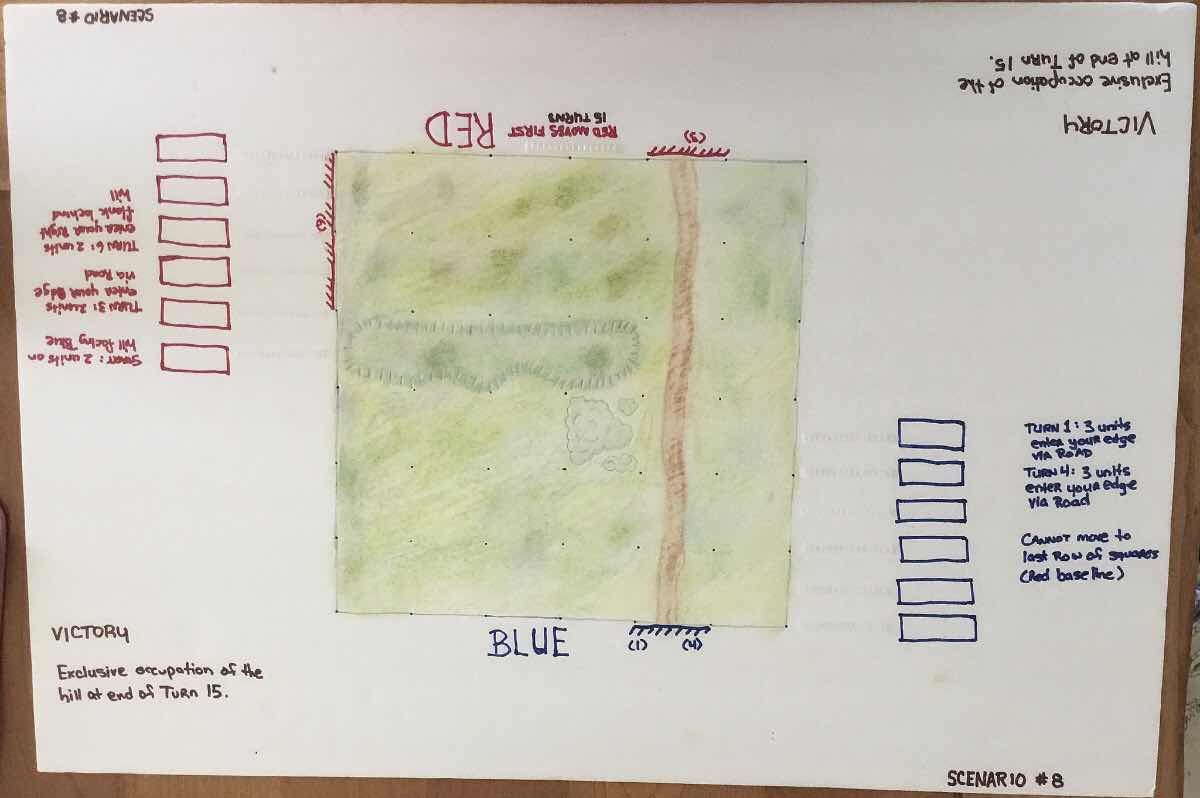
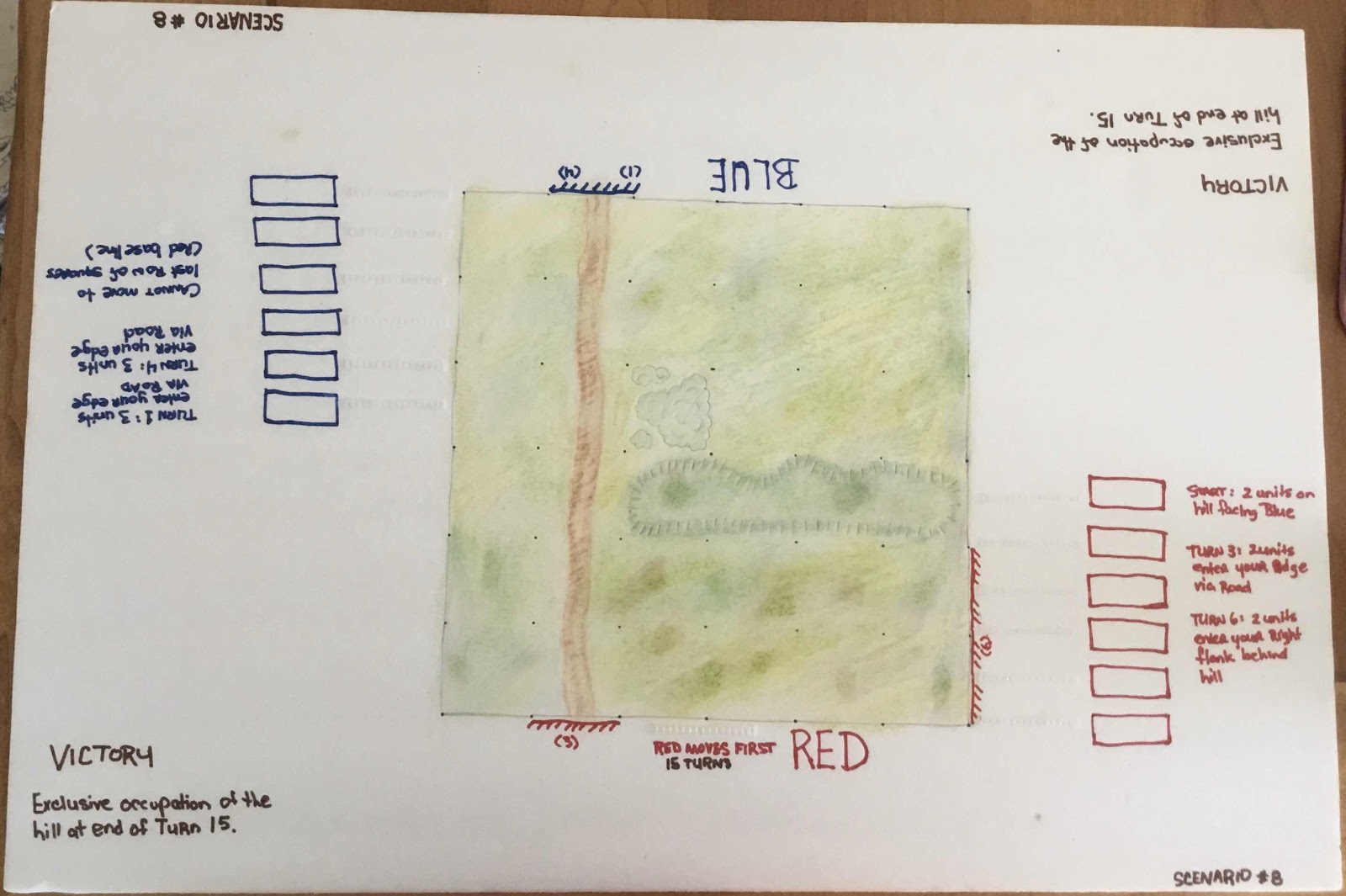
Because the terrain in Neil’s scenarios is very sparse, and has no random element in its placement, making a gameboard for an often played scenario makes sense. Here is what mine looks like for Scenario #8 – Mêlée.

This is the view from the Red side. 


Although it is hard to see (I should probably paint them) there are little strips of plastic needlepoint ‘grating’ to the left of the red boxes. You move a peg from hole to hole, indicating how many hits have been inflicted. There are 15 holes, so you can either handle units with 15 or 16 hits. The red boxes each hold markers to indicate which unit each represents. 


At the bottom is another strip with 15 holes, which is the turn track. Given than Red goes first, the turn track goes on his side.

This scenario has special rules around unit placement, reinforcements, and unit entry points. You can find those rules to the right of the unit tracks. Finally, there is the victory condition, found in the lower left-hand corner, to remind you to focus on the objective.

Here is a view of the Blue side. It has the same basic setup as the Red side, with the details differing, as per the scenario. There is no turn track, however.


The first game I am going to run is using 15mm DBA units, which is why the squares are 2”. They will, however, represent 6” of table space in the game given that the recommended frontage of units is 6”. So one unit horizontally for each square. (I am still pondering whether to allow multiple units in a square. For DBA units, as long as they do not exceed a depth of 40mm, I should be good.)

I have been tinkering with an idea for One-Hour Wargames, but as I have not played it ‘straight’ yet, I am holding off right now. Everyone has ideas on how to make it better, but there is only one concept I wish to model. (Things like Elites, Large Units, etc. I think can be modeled as scenario rules.) My concept is Fresh Units. Basically, as a unit wears down in combat, it becomes less effective. Some of Richard Borg’s games reflect that by granting more dice in the attack when you have more blocks or figures in the unit. (Others, like Memoir ‘44 do not modify the roll at all. It seems like the larger the game scale, the more likely he will allow units to roll full dice until they are destroyed.)

Rolling multiple dice and adding them to count the hits would make units disappear faster, so that would throw off things like scenario length, reinforcement rates, and so on. My idea is simple, units with: 0-4 hits would roll 2D6 and pick the highest; 5-9 hits would roll 1D6 (as normal); and 10-14 hits would roll 2D6 and pick the lowest. Because I use pegs and holes to record hits it would be easy to color code the strip to indicate whether the unit is Fresh (yellow), Worn (orange), or Exhausted (red).

So, a unit that is worn down a bit fighting through the first line, would (on average) not hit as hard as the unit in reserve in the second line. This mechanic would also have the side effect of encouraging the use of reserves. I think few games accomplish that.

Monday, February 18, 2013

Draft Aztec Battle Board for Saga

New Reader

First off, let me welcome new reader James Brewerton to the blog. Glad to have you on board. I welcome and appreciate comments. Now that I have a forum for Saga, feel free to post and join in the conversation.

Saga Updates

The Search for a Larger Army

The Mesoamerican Saga variant is humming along. In fact, I am digging this so much that I went out and bought some of the Tin Soldier UK Aztec miniatures that I don't already have. (I bought a painted collection of 450+ Tin Soldier Aztecs.) Now I am on the hunt for compatibly-sized miniatures.
  • I bought some The Assault Group (TAG) Aztecs and Tlaxcallans (hey! that is what they call them Bowman) and although they are nice, they are 28mm and would be big lads in the unit. Maybe okay for a separate unit, but not for mixing.
  • I bought some Ral Partha Aztecs on eBay, but was later told that they are puny and will not mix well with Tin Soldier.
  • The sculptor of the Eureka Miniatures 28mm Aztecs told me that his figures would not mix with Tin Soldiers either; they are too tall. Too bad because the Caymen "Knights" look really nice.
  • Monday Knight Productions has some 25mm Aztecs and [Conquistador] Native Allies, and as they are relatively inexpensive and in the U.S. I decided to order a handful.
  • Outpost Miniatures have a really extensive Mesoamerican range, but are listed as 28mm. I am hoping someone will know how they compare before I order some from the U.K. They look pretty chunky, but then again, so are Tin Soldiers.
  • I was told that the Foundry Miniatures Aztec line, although about 2-3mm taller, have the same body proportions and so should mix well.
  • It looks like no one sells Naismith Designs 25mm Aztecs anymore. They are supposed to be "true 25mm", which means that may be a little thin for Tin Soldier, even if I could get my hands on some.
The problem with Tin Soldier's figures is that they are almost too "characterful". They often have exaggerated poses, and because each figure type has only a single pose, they look like units of dancers. Sort of like the old Airfix figures and when you tried to make a battalion out of those guys that are charging.

I know that "Saga" and "large army" sounds a little out of place, but what if I want an eight-point army of (almost) every variation? Okay, so it won't be that bad. Besides, I am re-painting some of the Tin Soldier figures to be Tlaxcaltecs, and adding bits and pieces to get some variety. I am not sure if I am going to try any head swaps, however.

The Aztecs

Ralph the "Bowman Stringer" (or just Bowman) and I have been working hard thinking up ideas for the Aztec battle board and faction rules. So far I have all but four Saga abilities defined, although Chili Fires may be dropped if it proves inadequate or unworkable after testing.

By the way, this Mesoamerican Saga "supplement" will include a pronunciation guide!

The Aztec Tlacatecatl (Warlord) is armed with melee weapon, shield and atlatl. It has the same statistics as the standard Saga warlord.

The Cuauhocelotl (Hearthguard) may be armed with one of the following combinations:
  • Melee weapon and shield
  • Melee weapon, shield, and atlatl
  • Two-handed melee weapon and shield
Like the Vikings, you can purchase one unit of Cuachiques/Otomitl (Hearthguard) and promote them to 'Berserkers'. These figures are armed with melee weapon and shield.

The Yaoquizqui (Warriors) can be armed with melee weapon and shield or two-handed melee weapon and shield.

The Macehualtin (Levy) can be armed with sling or bow.

Two-Handed Melee Weapons

These are exactly the same as Danish Axes, with the attendant advantages and penalties.

Atlatl

This weapon operates just like a javelin, in that the unit can take a Movement action and receive a free Shooting action on the same activation. How it differs from the standard javelin rules is as follows:
  • The unit may only take a Shooting action (whether combined with a Movement action or not) when the unit is activated with the ability Weapon of the Gods. This means that only one unit1 may fire per turn.
  • The weapon can be fired to M range, but if fired from VS range the target's Armour value is reduced by 1.
Chili Fires

When the Chili Fires ability is played, the designated Macehualtin (Levy) unit indicates a target within L of it and rolls a D6. If the roll is a '2' through '6', the target unit takes one FATIGUE must retreat away from the Macehualtin unit. If the roll is a '1' the Macehualtin unit takes one FATIGUE and must retreat S towards its board edge.

There was a bit of discussion about whether this ability is appropriate or not. The "Chili Fires" weapon represents a unit of Macehualtin throwing chilis onto a fire when the wind is blowing in the correct direction and "tear gassing" the enemy. The basic problem with this idea is the thought of walking around with a ready-made fire while you are out on a raid. Looked at from that angle, it does not really make sense to have this weapon (and attendant ability).

However, the concept of a Dark Ages skirmish is not really that viable in Aztec warfare either. If you come at this with visions of Mel Gibson's Apocalypto in mind – Mayan warriors on slave raids – it might make sense. Instead, I am trying to use the Saga rules to play out a small portion of a larger battle with larger forces. Rather than repeat it all here, you can read my concept on what the game models on the Saga Variants forum. If you come at it from that angle, then committing the Macehualtin (Levy) to your force means you may also have them bringing their fires and chilis with them. As it stands, the unit can either fire L for damage, or use an ability to force you to retreat (and take a FATIGUE) … maybe. I think most people will choose to damage, at least until the unit gets whittled down and cannot do any real damage with their missile weapons.

I still have four abilities to fill for the Aztecs. (Actually, probably five, because the more I ponder the "utility" of Chili Fires the more convinced I am it is not worth allocating dice to it.) So if you have any ideas, either comment on the blog or the forum.

More Walkerloo Figures

I used to be a strong advocate of paper figures, as their cost is just so low it is easy to test out a new period or set of rules by printing up an army. I pulled away from it largely because I moved out of living full-time in my RV and bought a house and land (and a guest house, taken over as my semi-permanent Game Room). Having all this space let me collect armies, rules, terrain, etc., etc. Gone was the need to minimize the storage space of figures (paper armies store flat in envelopes). Gone was the limitation of having no painting or gaming space. Gone was my primary reason for using paper figures.

Of course, no matter what I do I cannot seem to get my act together, either in figure scale or rules, when it comes to Napoleonics. For figure scale I have more 6mm than anything, but I cannot decide on a basing scheme. I have about three or four I am currently using, thus it is really hard to do anything with them. As for rules … forget it. I really liked Drums and Shakos Large Battles, but gaming buddy Don did not.

I saw Chris Walker's Walkerloo figures quite some time ago. They are 1/35th scale Napoleonic paper figures for the Battle of Waterloo, and they are pretty good. The problem was he was selling the actual paper figures, not the digital files so that you could print out your own forces. (He even had a fun name, "printfantry", but that was only a few select figures that you could print out yourself.)

Eventually he realized that his business model was off (he wrote on his blog that he lost money on the venture) and finally decided to sell PDF files on Wargame Vault. Not only were there French and British (and a single Prussian Silesian Landwehr unit), but the Russian government commissioned him to create Russian figures for some promotion about the 200th anniversary of the Battle of Borodino (if I got the story right). Well today Walkerloo released not a Bavarian unit, but the Bavarian Corps. It includes line and light infantry, cavalry, artillery and commanders. All in one PDF file for $4.95.

Did I mention that I had already bought into the Walkerloo collection? Although I do not really have the same storage problems that I had in the past, it is still a great way to quickly get an army up and running if you want to try out a rule set. I own Lasalle and Napoleon at War and I have played neither, because the basing scheme for both is neither what I have, nor what I want to use (unless these rules turn out to be really good). Also, I still have this fantasy of playing someone using the Chef de Batallion rules.

Tournaments on Vassal

The BattleLore tournament on Vassal is still running. I have finished three of my six rounds, but have not been able to get anyone to play a tournament round all week. Everyone wants to play practice games or else they are people that are not in the tournament. This tournament has stimulated the online BattleLore on Vassal community, such as it is, and thus there are more people out there playing than in a long time. This week there were nine separate games, whereas before the tournament had started there were ten games the previous month, and Chris and I accounted for five of those!

I know, the numbers sound low, but we are talking about a "dead" game after all. Anyway, this has spurred other games to start tournaments on Vassal. I was originally signed up for a Command and Colors: Napoleonics on Vassal tournament, but due to an administrative error, ended up on the reserve roster (in case someone drops out). There is a signup sheet for Samurai Battles on Vassal and a second BattleLore on Vassal tournament also. I have signed up for the first, but am still thinking about the second. I need to make sure that the CCN tournament doesn't get me wrapped around an axle; they play two games per round.

Don owns Samurai Battles and although we have not played it, I have mixed feelings about it. First off, the figures are in pieces, literally. They are multi-part Zveda 1/76th plastic figures from their newly re-branded Samurai Battles line. Apparently once you put on the back banner (which identifies which side the unit is on, red or yellow) you are not going to get it off. (I have not looked closely at the figures, but my first thought was "magnets".) Secondly, I have heard of problems with missing cards and misprints. Richard Borg went online and published the corrected scenarios and has already posted an FAQ.

Interestingly, someone has posted a sheet to print stickers, so you can use wooden blocks for the units, just like GMT Games' Command and Colors series of games (Ancients and Napoleonics). I can see myself doing that, which means Don will never get his miniatures put together.

What draws me to Samurai Battles – other than a fascination with Samurai when I was young, compounded by my time spent in Japan while I was in the U.S. Marine Corps – is that it is very much like BattleLore. It has "Dragon" cards which are much like the Lore cards, only the effects are not so magic-oriented. More like dirty tricks, traps, events, and power-ups. I am reading the rules and will let you know what I think once I give it a try.

Well, that is about it for now. Good gaming!


1 If using the Weapon of the Gods ability on the Tlacatecatl (Warlord) it may also use its We Obey special rule to allow a Cuauhocelotl (Hearthguard) unit armed with atlatl to activate for a Movement action and also fire. This is the only exception to when more than one unit can use this ability in a single turn.
Wednesday, January 27, 2010

Working on Paper Sumerian and Akkadian Armies

I was feeling a little creative last weekend. I spent a lot of it writing for some new solo rules for DBA being developed, so I needed a break. I want a pike army, so I can practice both with and against them, but I have so many unpainted miniatures that I was reluctant to buy more.

I did work on a list of all the pike armies in DBA (must be able to select 4 or more pike elements to qualify as a "pike army") so I could see what my choices were. On a recent trip to Albuquerque, NM I was able to pick up an old copy of the WAB Supplement Chariots Wars and it had a section on the Sumerians, who in DBA are a pike army. So, as I am focusing on Biblicals/Chariot Wars of late (finished painting and basing my Philistine army and finished basing my New Kingdom Egyptians that I had painted for me), getting a Biblicals pike army seemed more interesting than the typical Macedonian/Successor or Swiss armies.

As this army, at least for now, I was going to use for solo play, and as I say I have a pile of lead, I decided to take a page from my old playbook and create a set of paper armies for this project. One of the reasons for that is because I am getting interested in trying my hand at Warhammer Ancient Battles, and those armies can get large (and thus expensive to build). I've always advocated for paper armies to experiment with, so here goes.

First up is the classic Sumerian pikeman with cape armor (to the right). I started with Patrick Crusiau's Swiss Pikeman and just started chopping bits here and there. The legs are from Patrick's Romans and the chest from Patrick's Gauls. I use Fireworks, so grafting it all together and filling in the blank spots is easy.

From there I was able to build a second pikeman (to the left), for the enemy army (they will probably Akkadians to start with). I took off the cape and thus had to draw more of the chest in, plus add the straps and large bronze boss on the chest.

One of the things that makes this easy with Fireworks is that I can work with both vectors and bitmaps. So the capes, shields, bosses, etc. are all separate objects, each on a different layer. So making variations of the same figure is much easier.

Next up is the two-handed axemen (to the right), the Blades element in DBA and the Guardsman in WAB. Basically I took the Pikeman, chopped off most of the pike, rotated it over the figure's shoulder, rotated the hand, then added an axe head to the end of it.

As you can see, you simply start building up a catalog of pieces to add and subtract as necessary and you can get a whole, well, army of variations in a short time. And you don't have to paint each figure! You only make the model once. (There I go again, advocating for paper armies...)

Last up is the first of the light infantry (to the right). It represents the Auxilia element in DBA and the non-skirmishing light infantry in WAB. It is an unarmored infantry with a hand axe and some javelins. (They really should be throwing sticks, but they did not look right without the spear points.) I used a throwing spear from Patrick's Gauls, chopped it down, resized them (so they were thinner), then made the heads even smaller. Also, I changed the colors from iron to bronze.

So, as you can see, the start of an army with not a whole lot of effort (less than 1/2 of a day). Of course they still need to be printed, glued, and based before they are an army.

Next to make are the archers. Also, I may go back and make variations of the above, adding beards, to distinguish the Sumerians from the Akkadians. The final piece will be the four-ass battlecarts (Heavy Chariots in DBA and WAB - although the latter has "ornery" rules for the asses).

Saturday, January 20, 2007

Bases for Paper Miniatures - Solved!

Ever since I discovered paper miniatures I have been enamored with the idea of creating vast, inexpensive armies from paper for the various rulesets I collect. Just bought a new Napoleonics ruleset and want to try them out, but they use a different basing scheme? No problem, just print up a new army!

Sounds good, but it is a little more complex than that. Printing the miniatures is no problem, even if you have to create new files for the new basing scheme. Gluing them together and cutting them out takes more time, but it is still not that problematic unless you want to start with a large army. But basing, now that is where it gets to be a problem.

On one hand you can simply glue the paper figures to the appropriate sized paper or cardboard base - that is what I did initially. But, others convinced me that I was throwing away one of paper's major advantages as a medium - the ability to store the figures flat, and thus store thousands of figures in the space where only dozens of lead figures could be stored. A 1" by 1" base with paper miniatures took up just as mucg space as a 1" by 1" base with lead or plastic miniatures.

So, that lead to the idea of having individual figures that could be easily mounted and removed from their bases. This way, the bases could easily be stacked on one another in a box and the figures stored in an envelope. Again, you could store thousands of figures and their bases in a very small space.

So the problem then became how to create a base where a figure could be easily mounted and removed, with minimal damage to the figure, and ease of building the base. This was a bigger problem than it sounded, actually.

I started with foam-core board. This worked pretty well, and I was getting a large collection of it for free at work (I worked next to a graphic arts department and they threw out a large number of scraps every day). The problem was cutting a slot wide enough to slide the figure into, but not too wide as the figure would wobble. Simply cutting a stroke halfway through the board wasn't good enough. Although it was fairly easy to do, the cut was not wide enough for two sheets of 110 lb. paper glued together to go through unless you bent the board. Of course, if you did that then the base would not sit flat. After awhile, the base would lose its tension and the figure would start wobbling. Of course, you could simply throw away the old base and make another, but I was looking for a more permanent solution.

Next up was cutting a slot in the foam-core. I used a cutting wheel from Dremel and that worked but it was a horrible mess. Also, the foam-core usually has formaldehyde in it, so inhaling the dust was not a good idea. Also, it was very easy to cut the slot too wide, so there were a lot of throw-aways.

Next I tried balsa wood. Again, just cutting the slot didn't produce a wide-enough gap, so I used an X-Acto saw blade. Again I noticed the tendency for the base to bow. Also, it was very hard to saw deep enough into the balsa without sawing all the way through.

Next I took balsa strips and glued them to balsa bases (also to metal washers). This worked pretty well. The figure slid in easily, there was no bowing of the base, and the results were pretty durable. At first the problem was getting the gap the proper width so the figure would not wobble, but I found that after I painted and flocked the bases the fit was nice and tight. The problem was that this method added tremendously to the time to get a unit up and running. In fact, the bases took far more time than the figures themselves.

So, one day I was staring at the office supply closet and thinking about this problem and it struck me that I had been using a solution all along: brass fasteners. Fasteners are used when you three-hole punch a document then need to bind them together. You stick these two-pronged fasteners into the holes and then spread the prongs apart to keep the pages together. I quickly grabbed a paper figure and yes, I could slide the figure into the slot between the two prongs into the fastener. Later I trimmed the prongs down and low and behold, I had a clip at the base of the figure.

As it turns out, even the smaller (1") fasteners are flat enough so that a figure clipped into it will stand upright without any problem; the larger (2") fasteners are just that much more stable and easier to grip when attaching the figure.

As I am doing more games with individually mounted figures, simply putting the figure into the clipped fastener is enough. Later, I can paint the brass grass green and maybe even add some flock, but that's not really necessary. When I want to play a game using multiple figures on a base, I simply glue clipped fasteners to a balsa wood base and slide the figures in. (You can paint and flock those bases over time too.)

As an aside, another method experimented with, and I am still considering, is to use magnets attached to the paper figure. A small enough magnet would not add considerable size to the figure (there are 2mm square rare earth magnets for sale on eBay) and you could embed another in the balsa base for a strong hold. But, I'll stick with brass fasteners for now.

Blog Archive

Blog and Forum Pages

Popular Posts

Followers

About Me

My photo
Huachuca City, Arizona, United States
I am 58 yrs old now. I bought a house in Huachuca City, AZ working for a software company for the last three years. To while away the hours I like to wargame -- with wooden, lead, and sometimes paper miniatures -- usually solo. Although I am a 'rules junkie', I almost always use rules of my own (I like to build upon others' ideas, but it seems like there is always something "missing" or "wrong").